
TLDR: SEO helps your business earn visibility in traditional search results, while GEO focuses on being discovered, mentioned or cited in AI-generated answers. For Texas businesses in 2026, the smarter approach is not choosing GEO vs SEO—it is building a search strategy that supports both.
GEO vs SEO is not really an either-or decision for Texas businesses in 2026; SEO remains the foundation, while GEO adds another layer for visibility across AI-powered search. If your business serves customers in Austin, Round Rock, Cedar Park, Georgetown or elsewhere in Texas, people can now discover you through traditional Google results as well as AI-powered experiences such as Google AI Overviews, AI Mode and ChatGPT search.
The important question is no longer simply, “How do I rank on Google?”
It is also:
“Will an AI system understand my business well enough to recommend or cite it?”
Is GEO Really Replacing SEO in 2026?
No, GEO is not replacing SEO; strong SEO fundamentals still support visibility in Google’s generative search experiences. Google’s current guidance specifically says that existing SEO practices remain relevant for AI Overviews and AI Mode, rather than requiring a completely separate optimization system.
Think of the difference this way:
SEO | GEO |
Focuses on search visibility | Focuses on AI-generated visibility |
Targets search engines | Targets generative search experiences |
Aims for rankings and clicks | Aims for mentions, citations and inclusion |
Strong technical foundation | Strong information and entity signals |
Traditional search remains important | AI search is an additional discovery layer |
For an Austin business, abandoning SEO to chase GEO would be a mistake.
The better strategy is to make your existing SEO work harder across both environments.
If you are still building your understanding of AI marketing, our guide to what is AI marketing explains how AI fits into broader marketing strategies beyond search visibility.
Where Do SEO and GEO Actually Overlap?
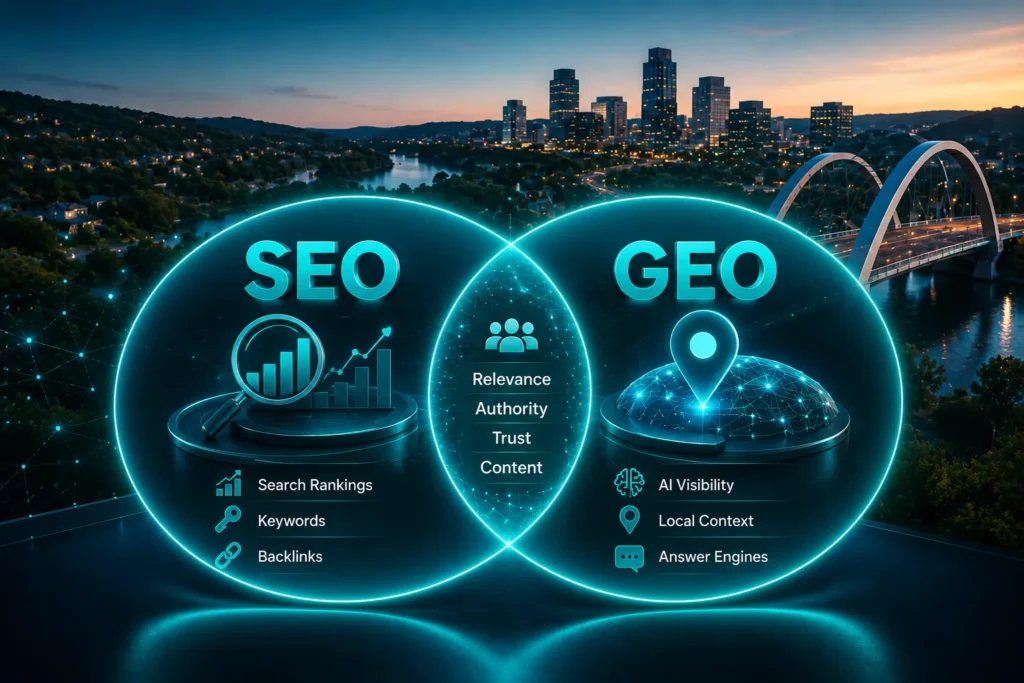
SEO and GEO overlap in many of the fundamentals that make a business website useful, accessible and trustworthy.
That includes:
- Helpful, original content
- Clear website structure
- Strong internal linking
- Accurate business information
- Local relevance
- Good technical SEO
- Structured data where appropriate
- Relevant third-party references
- Strong brand signals
- Demonstrable expertise
Google’s own 2026 documentation reinforces this point: businesses should continue following established SEO and quality practices when preparing content for its generative search features.
The difference is what happens after your content is discovered.
Traditional search may show:
AICOADS — AI Marketing Agency in Austin
An AI search experience may instead use information from multiple sources to answer:
“Which AI marketing agencies in Austin can help a local service business?”
That is the visibility shift GEO is designed to address.
What Does SEO Get Your Texas Business?
SEO helps your Texas business become discoverable when customers actively search for your services, products or information on traditional search engines.
For an Austin business, that can mean visibility for searches such as:
- AI marketing agency Austin
- digital marketing agency Austin TX
- AI marketing for plumbers
- HVAC marketing Austin
- local SEO Austin
- lead generation services Austin
SEO can also support visibility beyond Austin through location and service-specific content.
For example, a Texas company might build useful pages around:
Austin → Round Rock → Cedar Park → Georgetown
But each page should provide genuine local value rather than simply swapping city names.
A strong SEO strategy still needs:
- Relevant service pages
- Useful supporting content
- Local SEO
- Google Business Profile optimization
- Internal links
- Technical health
- Authoritative references
For businesses that need help connecting these pieces, AICOADS combines SEO, local search and AI marketing systems as part of its broader marketing approach.
Businesses comparing agencies can also review our guide to Austin digital marketing agencies using AI tools to see how different agencies approach AI-powered marketing.
What Does GEO Get Your Business That SEO Cannot?
GEO focuses on whether AI-powered search systems can understand your business and use your information when generating an answer.
A customer might ask:
“What’s the best AI marketing agency for a home service company in Austin?”
They may not see ten blue links first.
Instead, an AI system may produce a summarized answer with selected businesses or sources.
ChatGPT search, for example, can provide answers with links to relevant web sources and OpenAI says public websites can appear in ChatGPT search when they are accessible to its search crawler.
This makes several things increasingly important:
- Clear explanations
- Strong brand identity
- Consistent business information
- Useful local content
- Evidence of expertise
- Relevant third-party mentions
- Content that directly answers real questions
GEO is therefore less about “ranking at position one” and more about becoming a useful source within an answer.
How Does a Customer Find an Austin Business in Google vs AI?
Google traditionally asks the customer to choose from search results, while AI search can summarize information and provide recommendations or sources within the answer.
Consider a customer looking for marketing help.
Traditional search
They might search:
“AI marketing agency Austin”
Then compare:
- Organic results
- Map results
- Ads
- Reviews
- Websites
AI search
They might ask:
“Which AI marketing agency in Austin is best for a 5-person home service company?”
The system can consider the context of the question and return a synthesized answer with supporting sources.
That changes what your content needs to do.
A page shouldn’t only target a keyword.
It should also make clear:
- Who the business serves
- What it does
- Where it operates
- Which industries it understands
- What makes its approach different
- What evidence supports its claims
What Makes an Austin Business More Likely to Appear in AI Answers?
An Austin business is more likely to be understood by AI search when its website clearly explains who it is, what it offers, where it operates and who it serves. Keep business details consistent across the website and other trusted online sources, including its location, services, industries, service areas and expertise.
Clear answers also matter. Instead of vague claims such as “we provide innovative marketing solutions,” explain exactly what the business does and who it helps. For example, AICOADS explains its role as an Austin AI marketing agency and connects its services with specific business needs such as lead generation, automation and advertising.
Supporting evidence strengthens that understanding. Case studies, credible statistics, industry examples, expert insights and local content can give both customers and AI systems more context about a business. The goal is not to write for algorithms—it is to make the business information clear, specific and trustworthy.
Does Ranking on Google Automatically Make You Visible in ChatGPT?
No, ranking on Google does not guarantee that your business will appear in a ChatGPT answer. AI search systems use their own retrieval and ranking processes, and OpenAI states that ChatGPT search placement is not guaranteed.
That does not make SEO irrelevant.
Quite the opposite.
A technically accessible, useful and authoritative website gives AI systems more material to discover and evaluate.
For ChatGPT specifically, OpenAI says websites should avoid blocking OAI-SearchBot if they want their content to be discoverable, surfaced and cited in ChatGPT search.
So GEO isn’t a magic layer that sits completely apart from technical SEO.
If an AI system cannot access your content, there is nothing for it to evaluate.
Which Texas Businesses Should Prioritize GEO First?
Businesses that depend heavily on recommendations, comparisons and local discovery can benefit particularly from adding GEO to their existing SEO strategy.
This can include:
- HVAC Contractors
- Electricians
- Plumbers
- Home service companies
- Law firms
- Real estate businesses
- Healthcare practices
- SaaS companies
- Professional services
- B2B companies
- Local retailers
- E-commerce brands
For Austin’s contractor market, the opportunity is especially practical.
A homeowner may ask an AI system:
“Who are the best roofers in Austin?”
or:
“Which HVAC companies near Cedar Park offer emergency service?”
A business that only thinks about traditional rankings is preparing for one version of the search journey.
A business that builds strong local SEO and clear, authoritative content is preparing for both.
How Can You Build One Strategy That Covers Both SEO and GEO?
The most efficient approach is to build one strong content and local-search system, then optimize it for both traditional search and AI discovery.
Build this once | Use it for |
High-quality service pages | SEO + GEO |
Local content | Google + AI search |
FAQs | Search + AI answers |
Case studies | Trust + AI context |
Internal links | Discovery + topical authority |
Business information | Local SEO + entity clarity |
Expert content | E-E-A-T + AI citations |
Structured data | Search understanding |
This is where a connected marketing system becomes more useful than treating SEO and GEO as two completely separate projects.
AICOADS already combines services such as CRM automation, Google and Meta advertising, AI chatbots, funnels, SEO and AI search visibility rather than treating them as isolated channels.
How Should Texas Businesses Measure GEO in 2026?

Texas businesses can now use Google Search Console’s new Generative AI performance report to measure visibility in Google’s AI search features, including AI Overviews and AI Mode. Google launched this dedicated reporting in June 2026, making GSC much more useful for tracking GEO performance.
In Google Search Console, look at the Generative AI performance report to understand how your website is appearing through Google’s generative AI features. You can use it alongside the regular Performance report to monitor:
- Generative AI impressions
- Clicks from AI search
- Pages gaining AI visibility
- Overall AI search performance
Google also confirms that AI Mode data is now included in Search Console’s overall Performance report, so businesses can compare AI search activity with their wider organic search performance.
For an Austin business, GSC should become one part of your GEO measurement strategy. Combine its data with AI visibility checks across platforms such as ChatGPT and Perplexity, then connect that visibility to website enquiries, leads and conversions.

What Should an Austin Business Do First?
An Austin business should strengthen its SEO foundation first, then add GEO-focused content and measurement rather than replacing its existing search strategy. A practical starting point is:- Audit your existing SEO
- Improve important service and industry pages
- Strengthen Austin and Texas local signals
- Create direct-answer content around real customer questions
- Add useful case studies and original evidence
- Make internal linking more intentional
- Check that important pages are accessible to relevant AI crawlers
- Start monitoring AI search visibility