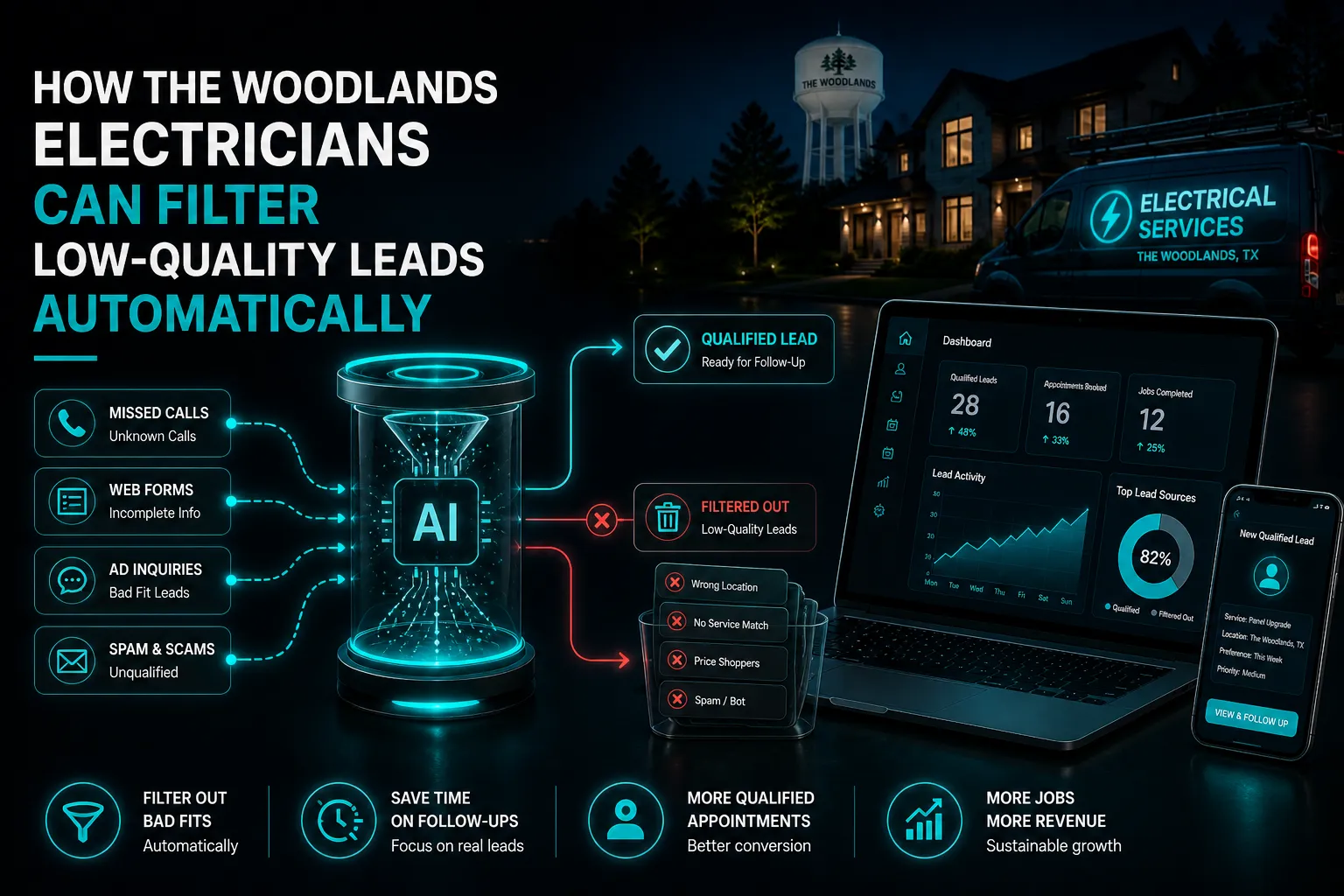
Why Do Electricians Receive Low-Quality Leads?
Electrical contractors may receive inquiries from outside their service area, customers requesting unsupported work, duplicate submissions, or people who have not yet decided what service they need. These inquiries can create extra calls and administrative work when every lead enters the same sales process.
A stronger pipeline starts with effective lead generation strategies that attract prospects who match your services.
Common examples include:
- Out-of-area requests: The property is outside the contractor’s approved service locations.
- Unsupported services: The customer needs work the company does not offer.
- Duplicate inquiries: The same person submits multiple forms or contacts the business through different channels.
- Incomplete details: The inquiry lacks a usable phone number, property location, or clear service request.
- Early-stage research: The person is exploring options but is not ready to schedule an assessment.
Not every early-stage inquiry is a bad lead. Someone researching an electrical panel upgrade today may become a customer later. An effective filtering system identifies the difference between a request that genuinely falls outside the company’s scope and one that simply needs clarification or nurturing.
Which Leads Should Electrical Contractors Filter Out?
The first step is to define which inquiries qualify for immediate follow-up, which need more information, and which should be declined politely.
| Lead type | Qualification signal | Recommended action |
| Out-of-area request | Address falls outside confirmed coverage | Explain coverage limitations |
| Unsupported service | Requested work is not offered | Provide an appropriate response or referral if available |
| Duplicate inquiry | Matching contact and job details already exist | Update the existing CRM record |
| Incomplete inquiry | Essential contact or service details are missing | Ask a brief follow-up question |
| Unclear project intent | Customer has not specified the work needed | Offer clarification or a discovery conversation |
| Suitable service request | Service and location match company rules | Route to the relevant team |
| Potential future project | Customer is interested but not ready | Add to an appropriate follow-up workflow |
These categories should be configured around the contractor’s real operating requirements. For example, a company that handles residential repairs but not large commercial installations needs different qualification rules from a contractor specializing in commercial electrical projects.
Avoid using a customer’s unwillingness to disclose a budget as an automatic rejection rule. For many electrical jobs, the customer needs an assessment before they can reasonably estimate the cost.
Learn how AI marketing helps businesses automate lead management while keeping qualification rules consistent.
How Can AI Filter Low-Quality Electrician Leads Automatically?
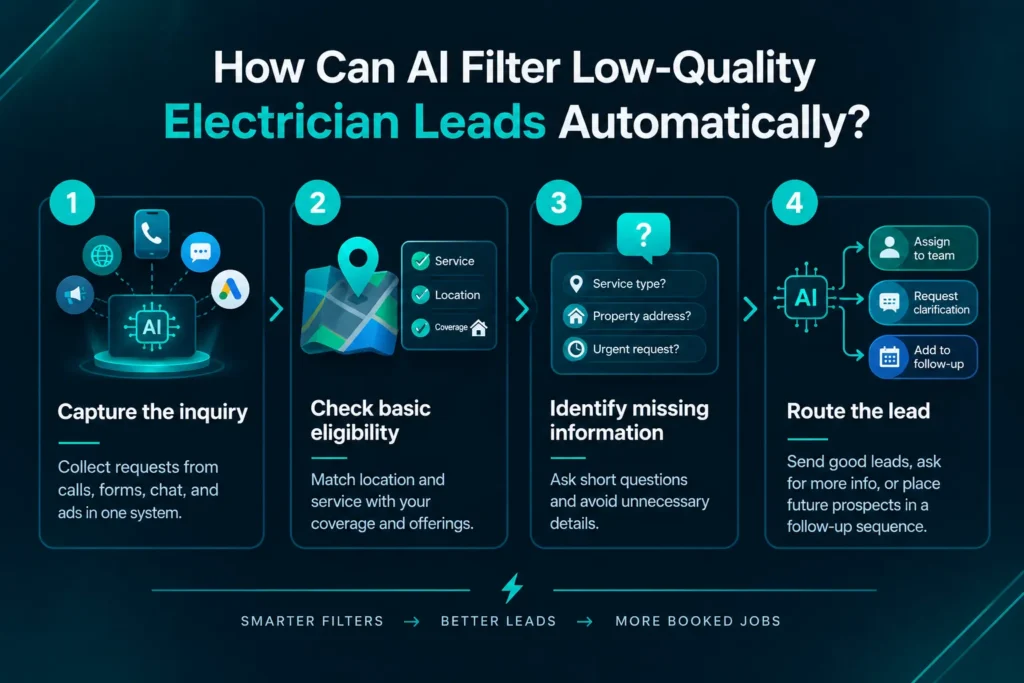
AI lead filtering combines information collection with predefined business rules. Instead of sending every inquiry directly to a salesperson, the system checks whether the request matches the contractor’s services, coverage, and qualification requirements.
A practical workflow includes four steps.
- Capture the inquiry. Collect requests from phone calls, website forms, chat, and supported advertising channels in one organized system.
- Check basic eligibility. Compare the customer’s location and requested service with the contractor’s actual coverage and service list.
- Identify missing information. Ask concise questions when the system cannot determine whether the inquiry is suitable. Avoid asking for information that will not affect the next action.
- Route the lead. Send suitable requests to the appropriate employee, request clarification for incomplete inquiries, and place appropriate longer-term prospects into a follow-up sequence.
For inquiries that need more context, customer photos for electrician lead qualification can help clarify visible job requirements.
AI should not invent service availability, provide unapproved prices, or diagnose electrical faults. Potential safety emergencies must follow a separate escalation process with clear human involvement.
This approach builds on the principles covered in AICOADS’ article about AI lead qualification for electricians.
What Questions Help Qualify Electrical Leads?
A useful qualification conversation gathers only the details needed to determine the next step. Long questionnaires can frustrate potential customers and cause suitable leads to abandon the process.
Electricians can start with these questions:
- What electrical service do you need?
- What is the property’s address or ZIP code?
- Is the request for a repair, installation, inspection, or estimate?
- Is there an urgent safety concern?
- When would you prefer the work to take place?
- What is the best way to contact you?
Additional questions can depend on the service. For an EV charger installation, the contractor might need to know whether the project is residential or commercial. For a panel upgrade, the team may need to arrange an assessment before confirming the project’s scope.
The AI should use these answers to categorize the inquiry, not make technical decisions that require an electrician.
For urgent hazards, such as smoke, sparks, or exposed live wiring, the system should follow the company’s safety escalation procedure and direct the caller to appropriate emergency assistance. These cases should never be treated as ordinary low-quality leads simply because they do not fit a standard booking workflow.
How Does an Electrician Lead Scoring Work?
Lead scoring assigns values to specific signals so a contractor can prioritize follow-up. The most useful signals are based on the company’s actual services and sales process, not arbitrary assumptions about customer quality.
A well-planned CRM implementation process helps teams turn lead scores into clear follow-up actions.
For example, an electrical contractor might evaluate:
- Service fit: Does the company perform the requested work?
- Location fit: Is the property within its service area?
- Information completeness: Can the team contact the prospect and understand the request?
- Timing: Is the customer planning work soon or exploring a future project?
- Next-step readiness: Is the prospect requesting an appointment, estimate, or additional information?
The resulting categories might be high priority, need clarification, and future follow-up. A high-priority request can be assigned to staff promptly. An incomplete inquiry can trigger a short clarification message, while a suitable future project can enter a relevant nurture workflow.
These categories are examples, not industry benchmarks. Review actual outcomes to determine whether your scoring rules identify leads that become booked jobs.
Most importantly, a low score should not automatically mean a lead is discarded. If the system cannot confidently determine whether a prospect is suitable, it should request more information or route the inquiry to a person.
How Can CRM Automation Prevent Good Leads From Being Lost?
Filtering works best when it connects directly to a CRM. Without that connection, staff may still need to copy information manually, search for duplicate contacts, and remember which prospects require follow-up.
CRM automation can create or update contact records, save the requested service, assign ownership, and trigger reminders. It can also track whether a lead was contacted, booked, declined, or placed into a future follow-up sequence.
For example, a homeowner requesting an electrical panel upgrade might qualify for an estimate but need an assessment before receiving a quote. The CRM can assign the inquiry to the relevant team member and create a follow-up task if the customer has not scheduled the next step.
Explore AICOADS’ CRM automation services and AI receptionist service for related lead-capture and follow-up workflows. Contractors using compatible field-service tools can also explore the Jobber and GoHighLevel integration guide.
How Can The Woodlands Electricians Set Up Automatic Lead Filtering?
Start with a straightforward implementation rather than trying to automate every decision at once.
- Define your service criteria. List the electrical services you offer, the locations you cover, and the types of projects your team can handle.
- Separate rejection rules from clarification rules. An unsupported service may require a polite decline, while an incomplete inquiry usually needs another question.
- Connect your lead sources. Bring supported phone, form, chat, and advertising inquiries into a central workflow.
- Configure CRM routing. Assign suitable leads to the right team and create follow-up tasks for prospects who need more information.
- Test real examples. Check out-of-area requests, duplicate submissions, urgent concerns, and suitable installation inquiries before launching.
- Review results regularly. Track qualified leads, appointments, follow-up completion, and jobs won. If good prospects are repeatedly being filtered out, adjust the rules.
For more context on the value of responding to inquiries, read AICOADS’ guide to missed calls and lost opportunities for Texas contractors. Better lead filtering and consistent response processes work together: one helps identify suitable prospects, while the other helps your team act on them.
FAQs About Electrician Lead Qualification
How can electricians identify duplicate leads from multiple sources?
Electricians can identify duplicate leads using CRM automation that compares phone numbers, email addresses, property locations, and job details. Potential matches can be flagged to prevent repeated follow-ups.
Should electricians automatically reject leads that do not include a budget?
No, electricians should not reject leads solely because a budget is missing. They can ask about the project scope and timeline to determine whether the inquiry is worth pursuing.
How often should electrical contractors update their lead-filtering rules?
Electrical contractors should review their lead-filtering rules monthly during the initial rollout. Comparing filtered leads with booked jobs helps identify mistakes and improve qualification criteria.
Can AI filter electrician leads from Google Ads and website forms?
Yes, AI can filter leads from Google Ads and website forms when connected to a compatible CRM. It can check service areas, requested work, duplicate records, and missing information.
What should electricians do with leads that do not meet every qualification requirement?
Electricians should send uncertain leads for clarification or manual review instead of rejecting them automatically. This helps identify potential customers who simply need to provide more information.
Improve Electrician Lead Qualification in The Woodlands, TX
Automatically filtering poor-fit inquiries can help electrical contractors protect staff time, organize incoming requests, and prioritize suitable projects. The best system combines clear service-area rules, useful qualification questions, sensible lead scoring, and reliable CRM follow-up.
AICOADS helps businesses connect AI lead capture and CRM automation into coordinated workflows. Explore our AI marketing and automation services or contact AICOADS to discuss a lead qualification process tailored to your business.