
Why Do Roofing Contractors in Austin Need a Professional Website?
Austin roofing companies compete for homeowners searching for reliable contractors, especially after hailstorms and severe weather. A professional website helps your business establish credibility and explain why customers should choose your services.
A well-designed roofing website can:
- Build trust through reviews, certifications, and project photos.
- Explain your roofing services and service areas.
- Attract homeowners through local search visibility.
- Generate phone calls and estimate requests.
- Support Google Ads and other marketing campaigns.
- Capture inquiries even when your office is unavailable.
Your website should function as a lead generation tool rather than simply an online business card.
What Should a High-Converting Roofing Contractor Website Include?
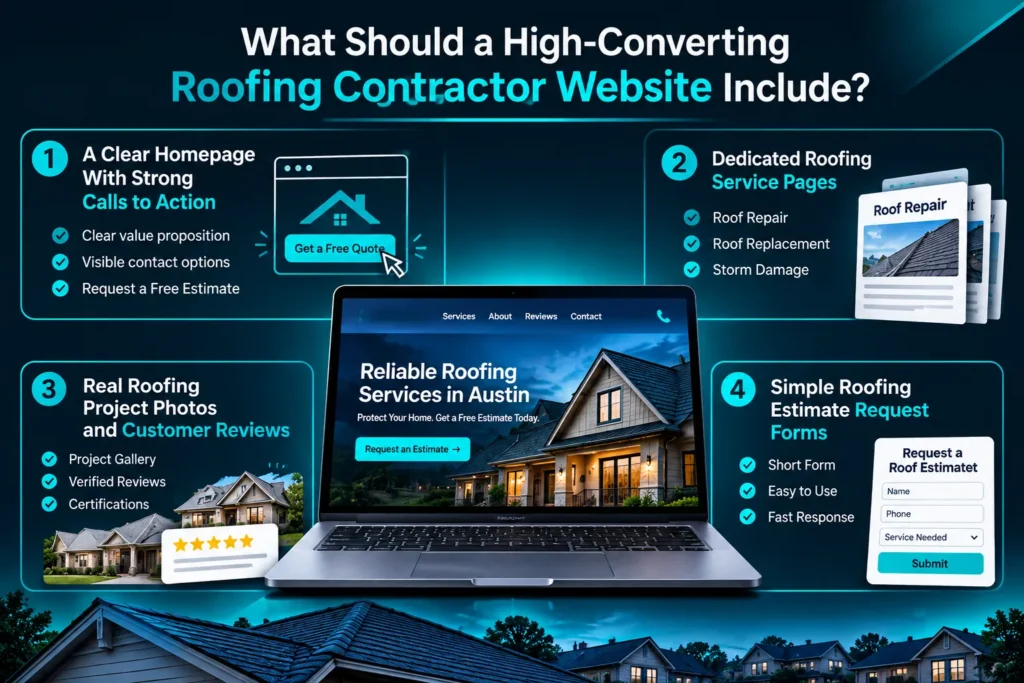
A roofing company website should make it easy for homeowners to understand your services, evaluate your experience, and request an inspection.
1. A Clear Homepage With Strong Calls to Action
Your homepage should immediately explain what your company does and where it operates.
Include a clear headline, a short description of your roofing services, and visible contact options. For example, a headline such as “Reliable Roof Repair and Replacement in Austin, TX” communicates your location and primary services.
Add prominent calls to action such as:
- Request a Free Roofing Estimate
- Schedule a Roof Inspection
- Call Our Roofing Team
Display your phone number near the top of the page so mobile visitors can contact you without searching through multiple sections.
2. Dedicated Roofing Service Pages
Avoid placing every service on one general page. Create separate pages for the services your company actually provides.
Examples include:
- Roof repair
- Roof replacement
- Residential roofing
- Commercial roofing
- Hail and storm damage inspections
- Emergency roof repair
Dedicated service pages allow you to explain each solution, address customer questions, and target relevant search terms. They also give Google a clearer understanding of your website’s content.
3. Real Roofing Project Photos and Customer Reviews
Homeowners want evidence that a contractor can complete the work professionally. Use genuine project photos, before-and-after images, customer testimonials, and relevant certifications to demonstrate experience.
Include information about warranties, materials, workmanship, and your team’s background where applicable.
For additional credibility, connect your website to your Google Business Profile and make it easy for visitors to find your customer reviews.
4. Simple Roofing Estimate Request Forms
A complicated contact form can discourage homeowners from submitting inquiries.
Keep your roofing estimate request form straightforward. Ask for essential information such as:
- Customer name
- Phone number
- Email address
- Property location
- Type of roofing service needed
Avoid requesting unnecessary details at the first stage. After submission, display a confirmation message explaining when the customer can expect a response.
How Does Mobile-Friendly Website Design Help Roofers Get More Leads?
Many homeowners search for roofing contractors using their smartphones. A mobile-friendly roofing website makes it easier for visitors to call, explore services, and request estimates from any device.
Prioritize these features:
- Responsive layouts that adjust to different screen sizes.
- Click-to-call phone numbers.
- Fast-loading pages and optimized images.
- Easy-to-use navigation.
- Short forms with clearly labeled fields.
- Visible contact buttons.
Test your website on different mobile devices before publishing. Make sure important information and calls to action remain accessible without excessive scrolling or zooming.
How Can Roofing Contractors Improve Website SEO in Austin?
Professional roofing website design should support search engine optimization from the beginning. A visually attractive website will not generate consistent organic traffic if its pages are difficult for search engines to understand.
Focus on these SEO fundamentals:
Target relevant local keywords: Use phrases such as roofing website design Austin, Austin roofing company, roof repair Austin, and roofing contractors Austin TX where relevant to your content.
Create useful service-area pages: Explain the roofing services available in the locations you genuinely serve. Avoid publishing repetitive city pages with little unique information.
Optimize page titles and descriptions: Write unique titles and meta descriptions that communicate the page’s purpose and encourage relevant clicks.
Improve technical performance: Use optimized images, secure HTTPS, mobile-friendly layouts, logical URLs, and a clear website structure.
Build relevant internal links: Connect your service pages, roofing resources, case studies, and contact page to help visitors navigate your website.
For more guidance, explore roofing marketing in Austin, which covers local visibility, advertising, and lead generation for roofing businesses.
Why Should Roofing Websites Have Dedicated Storm Damage Landing Pages?
Storm damage can create urgent demand for roof inspections and repairs. A dedicated landing page helps Austin roofing contractors communicate their storm-related services to homeowners searching for assistance.
A storm damage page should explain:
- Which storm-related roofing services you provide.
- How homeowners can request an inspection.
- What information to prepare before contacting your team.
- Your service area and contact details.
- Relevant project photos and customer reviews.
If you run Google Ads or storm-related campaigns, send visitors to a focused landing page instead of a generic homepage. This keeps the message consistent from advertisement to inquiry.
You can also read Roofing Storm Leads in Round Rock for more ideas on capturing and managing storm-related opportunities.
How Can CRM Automation Turn Roofing Website Inquiries Into Booked Jobs?
Getting an inquiry is only the beginning. Roofing contractors also need a reliable process for responding to homeowners, organizing leads, and arranging inspections.
CRM automation can connect your website forms and phone inquiries to a centralized lead management system.
A typical workflow includes:
- Capture the inquiry: Send website form submissions directly into your CRM.
- Send confirmation: Automatically acknowledge the homeowner’s request through SMS or email.
- Notify your team: Assign the inquiry to the appropriate sales representative.
- Schedule follow-up: Create reminders for unanswered inquiries and pending estimates.
- Book inspections: Give interested homeowners a convenient way to arrange appointments.
An AI receptionist can also help handle incoming calls and capture inquiries when your office team is busy.
For more roofing-specific examples, explore AI Roofing Lead Follow-Up in Round Rock and Roofing Estimate Reactivation in Round Rock.
How Much Does Roofing Website Design Cost in Austin?
Roofing website design costs depend on the size, functionality, and requirements of the project. A basic template-based website generally requires less work than a custom website with multiple service pages, local SEO, CRM integration, and conversion tracking.
Common pricing factors include:
Website requirement | What affects the cost |
Custom design | Layout, branding, and development complexity |
Service pages | Number of roofing services covered |
Local SEO | Keyword research and on-page optimization |
Lead capture | Forms, call tracking, and CRM integration |
Content creation | Service descriptions, images, and copywriting |
Maintenance | Updates, security, and ongoing improvements |
Instead of choosing a website based only on its initial price, evaluate whether it supports your long-term lead generation goals.
Learn more about landing page optimization in Austin and how conversion-focused pages can improve the performance of marketing campaigns.
Frequently Asked Questions
What should a roofing contractor website include?
A roofing website should include a clear homepage, individual service pages, project galleries, customer reviews, contact information, estimate request forms, and mobile-friendly navigation.
How can roofing companies get more leads from their websites?
Roofing companies can improve lead generation through local SEO, dedicated service pages, clear calls to action, simple contact forms, customer testimonials, and automated follow-up.
Why is mobile-friendly design important for roofing websites?
Mobile-friendly design helps homeowners quickly find services, call contractors, view project information, and submit estimate requests from smartphones.
How long does it take to build a roofing contractor website?
The timeline depends on the website’s size, design requirements, content, and integrations. A smaller website may take a few weeks, while a larger custom project can require more development and testing.
Can website design improve local SEO for roofing companies?
Yes. A well-structured website with relevant service pages, location information, optimized content, mobile usability, and technical SEO can support local search visibility.
Turn Your Roofing Website Into a Lead Generation System
Your roofing website should help homeowners find your business, understand your services, and take the next step toward booking an inspection. With professional design, local SEO, clear calls to action, and automated lead management, Austin roofing contractors can build a stronger online presence and create more opportunities to win projects.
Explore AICOADS website design services to build a website designed to support your roofing business growth.