What are AI Marketing Solutions for Austin Businesses?
AI marketing solutions are connected tools and workflows that use artificial intelligence and automation to improve how a business attracts, captures, qualifies, and follows up with customers.
For an Austin business, this could include:
- AI website chat
- Lead capture automation
- Automated email and SMS follow up
- CRM workflows
- AI voice agents
- Appointment booking
- Lead qualification
- Marketing reporting
- Content assistance
- AI search visibility
The important difference is between an AI tool and an AI marketing system.
An AI tool might write an email or answer a question. An AI marketing system connects several steps together. For example, someone submits a form on your website. The system can immediately send a response, qualify the lead, create a CRM record, notify the sales team, and offer an appointment.
That is much more useful than simply adding an AI chatbot to a website.
For businesses that want to build this kind of connected workflow, CRM and marketing automation can provide the foundation for managing leads and customer interactions.
What Should an Austin Business Automate First?
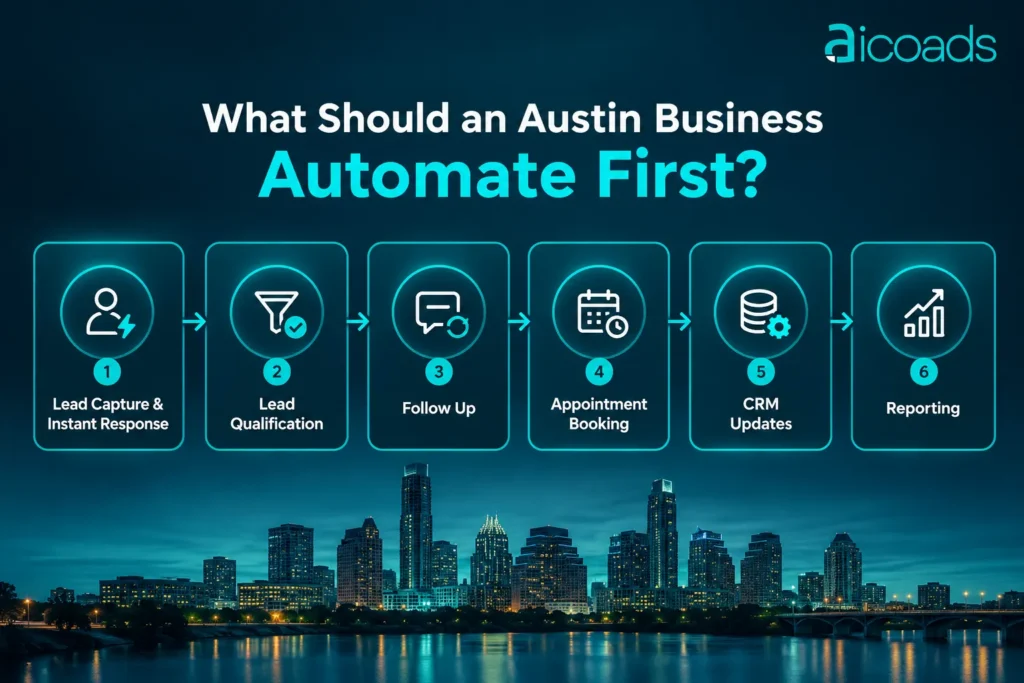
Austin businesses should usually automate lead response and follow up first because these tasks are repetitive, time sensitive and directly connected to revenue.
A practical priority order is:
1. Lead Capture and Instant Response
Automate the first response to website forms, advertising leads, chat inquiries and other inbound contacts.
A prospect who submits an inquiry should receive a confirmation quickly instead of waiting for someone to notice an email.
For businesses that receive a high volume of calls, an AI receptionist service for Austin businesses can also help respond to missed calls, answer common questions and move prospects toward an appointment.
2. Lead Qualification
AI can ask basic questions about the prospect’s needs, location, company size, service requirements, timeline or budget.
This helps sales teams spend more time with qualified opportunities.
For technology and software companies, B2B lead generation for tech and software companies can combine prospect targeting and qualification with automated workflows.
3. Follow Up
Follow up is one of the easiest marketing tasks to automate.
A system can send reminders when someone does not respond, provide additional information, and keep qualified prospects in a nurture sequence.
4. Appointment Booking
Automate booking links, confirmations, reminders, rescheduling and no show follow up.
This removes unnecessary back and forth between the prospect and sales team.
5. CRM Updates
Lead information should move automatically into the correct CRM pipeline and stage.
Instead of manually updating every contact, workflows can respond to actions such as form submissions, booked meetings, completed calls or changes in lead status.
6. Reporting
Automate recurring reports showing leads, appointments, conversion rates, advertising performance, pipeline and revenue by source.
The goal is to make performance information available without manually building reports every week.
Which Marketing Tasks Should You Not Automate First?
Businesses should not automate every marketing activity simply because AI can perform it. Strategy, brand decisions, complex sales conversations and sensitive customer interactions still require human judgment.
Avoid making these your first automation projects:
- Your entire content strategy
- Brand positioning
- Complex sales negotiations
- Pricing decisions
- High value customer complaints
- Final creative approval
- Sensitive customer communication
- Business strategy
For example, AI can help draft content, but automatically publishing hundreds of generic articles is unlikely to create a strong brand or meaningful search visibility.
The same principle applies to sales. AI can qualify a lead and schedule a meeting, but a human should usually handle a complex consultation where trust, context and expertise matter.
The best rule is simple:
Automate repetitive work. Keep human judgment where it creates value.
How Should an Austin Business Decide What to Automate?
An Austin business should prioritize automation based on frequency, revenue impact, response time, repetition and risk.
Ask five questions about every potential workflow:
Question | What to look for |
How often does it happen? | Tasks performed every day are strong candidates |
Does it affect revenue? | Prioritize tasks connected to leads and sales |
Is timing important? | Automate tasks where delays can lose opportunities |
Is it repetitive? | Repeated actions are easier to systemize |
What happens if it makes a mistake? | High risk tasks need human oversight |
This creates a simple rule:
High frequency + high revenue impact + low risk = automate first.
For example, sending an appointment reminder may happen hundreds of times and involve little risk. It is an excellent automation candidate.
Negotiating a major contract is different. It may have high revenue impact, but it requires judgment and should remain primarily human.
The same principle applies to content and search marketing. Businesses should establish their core marketing strategy before adding advanced AI workflows. For search visibility, GEO vs SEO is useful for understanding how traditional search optimization and AI search visibility can work together.
What Does an AI Marketing System Look Like for an Austin Business?
An AI marketing system connects different stages of the customer journey instead of using separate tools that do not communicate with each other.
A simple system can look like this:
Traffic → Lead Capture → AI Response → Qualification → CRM → Appointment → Follow Up → Sales → Retention
Before a lead arrives, AI and automation can support advertising, content, audience targeting, SEO and AI search visibility. For businesses that need more qualified prospects, B2B lead generation can connect acquisition with automated lead management.
When the lead arrives, automation can capture the information, respond immediately, qualify the prospect and route the opportunity to the right person.
For companies selling technology and managed services, IT services lead generation in Austin can also connect lead acquisition with qualification, CRM management and automated follow up.
After the initial interaction, the system can manage appointment reminders, follow up, nurture campaigns and sales pipeline updates. For businesses selling software or other B2B services, SaaS lead generation in Austin can also be connected to CRM workflows, lead scoring and automated follow up.
Once someone becomes a customer, automation can support review requests, referrals, retention campaigns and re engagement.
The value comes from connecting these activities.
For example, a website visitor who submits a form should not become an isolated contact inside an inbox. Their information should move into the CRM, trigger the appropriate workflow, and give the sales team visibility into what happened before the conversation.
This is also why AI marketing and CRM automation work best together. AI can make decisions or assist with communication, while the CRM provides the structure for managing the customer journey.
Businesses that want to appear more consistently across AI generated answers can also explore Answer Engine Optimization for Austin businesses as part of their broader search strategy.
How Much Do AI Marketing Solutions Cost in Austin, TX?
The cost of AI marketing solutions in Austin, TX depends on how many processes are being automated and how much customization the business requires.
A simple lead follow up workflow may require far less investment than a complete system involving CRM automation, AI voice agents, advertising, landing pages, and multiple integrations.
Solution | Complexity | Main Cost Factors |
Lead response automation | Low | CRM and messaging |
Appointment automation | Low to medium | CRM and calendar |
AI chatbot | Medium | Platform and customization |
CRM automation | Medium to high | Workflows and integrations |
AI voice agent | High | Voice platform and usage |
Full AI marketing system | High | Multiple connected systems |
The right question is not simply, “How much does AI marketing cost?”
It is:
How much revenue or operating time can the automation create or save?
A business that loses qualified leads because nobody follows up quickly may benefit more from a relatively simple CRM workflow than from investing heavily in advanced AI content tools.
AICOADS currently structures its marketing services around connected systems that can include CRM automation, AI engagement, advertising, landing pages, lead generation and AI search visibility.
What AI Marketing Solutions Work Best for Different Austin Businesses?
The best AI marketing solution depends on how a business generates leads, how often customers contact it and where manual work creates bottlenecks.
Business Type | Useful First Automation |
Home service businesses | Missed call response and appointment booking |
Professional services | Lead qualification and follow up |
SaaS companies | Lead scoring and trial follow up |
B2B companies | Lead enrichment and outbound follow up |
Real estate | Lead routing and appointment booking |
Law firms | Lead intake and qualification |
Marketing agencies | CRM, reporting and lead workflows |
E commerce | Customer support and re engagement |
How Long Does It Take to Implement AI Marketing Automation?
Basic AI marketing automation can often be implemented within days or a few weeks, while larger systems with multiple integrations require more planning and testing.
A practical rollout can look like this:
Timeline | Focus |
Days 1 to 14 | CRM setup, lead capture, instant response, and basic pipeline |
Days 15 to 30 | Qualification, booking, reminders, and follow up |
Days 31 to 60 | Nurture, reporting, segmentation, and optimization |
Days 61 to 90 | Advanced AI workflows, search visibility, and additional integrations |
Starting small is usually better than attempting to automate the entire customer journey immediately.
Once the first workflow is producing reliable results, the business can identify the next bottleneck and automate that process.
Businesses that want to understand how different AI-focused agencies approach this work can also review Austin digital marketing agencies using AI tools before selecting a provider.
Final Thoughts
Austin businesses do not need to automate everything to benefit from AI marketing.
They should start with the workflow closest to revenue.
For most lead driven businesses, that means improving lead capture, response time, qualification, follow up, appointment booking, and CRM management before moving into more advanced automation.
The goal is not to have the most AI tools.
The goal is to build a marketing system that responds faster, wastes less time, converts more opportunities, and gives the business better visibility into its pipeline.
When automation is connected to real business outcomes, AI becomes more than a productivity tool. It becomes part of the growth system.