
Why Does Lead Generation Matter for Austin Startups?
Austin has a diverse startup ecosystem, with companies operating across technology, software, healthcare, fintech, AI, and other industries. This creates opportunities, but it also means startups compete for the attention of customers, investors, and business partners.
Early-stage companies often have limited marketing budgets and small sales teams. Without a consistent lead generation process, founders may depend entirely on referrals, personal networks, or occasional outreach.
A structured approach helps startups:
- Reach decision-makers in their target market.
- Generate qualified leads instead of irrelevant inquiries.
- Build a consistent sales pipeline.
- Reduce dependence on referrals.
- Measure customer acquisition costs.
- Improve conversion rates over time.
The goal is not to generate the highest number of leads. It is to attract prospects who are more likely to become paying customers.
How Can Startups in Austin Build an Effective Lead Generation Strategy?
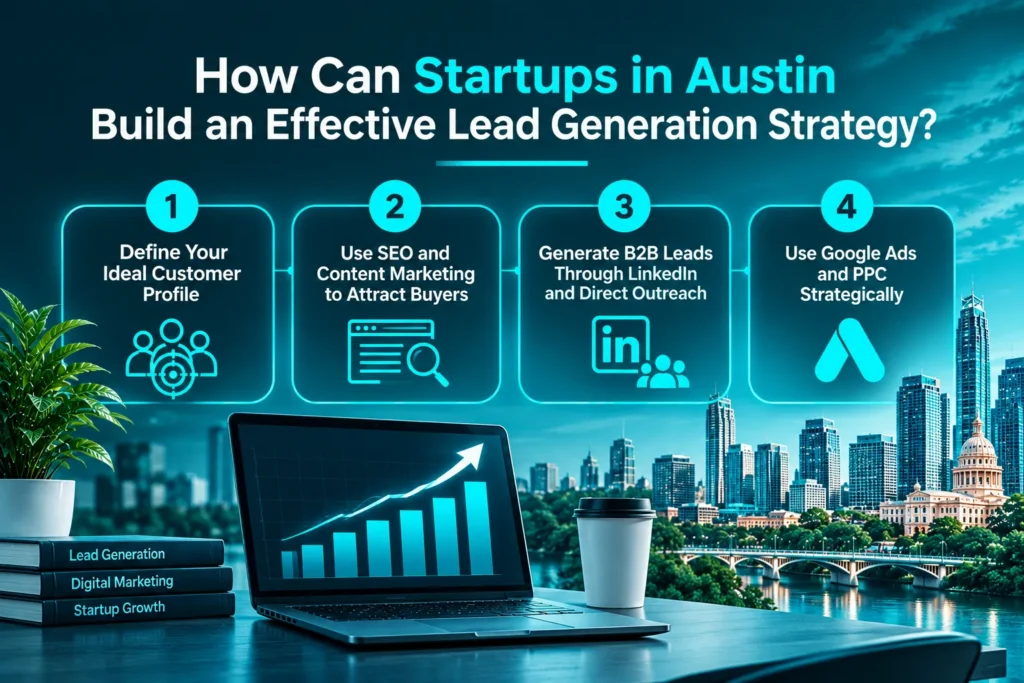
A successful startup lead generation strategy begins with a clear target audience and develops through repeatable acquisition and conversion activities.
1. Define Your Ideal Customer Profile
Before investing in advertising or outreach, identify the businesses or individuals most likely to purchase your product.
For B2B startups, define your ideal customer profile (ICP) using:
- Industry and business type.
- Company size and annual revenue.
- Location and target market.
- Decision-maker roles.
- Common operational challenges.
- Budget and purchasing readiness.
For example, an Austin-based CRM startup might target small and midsize businesses with growing sales teams that struggle to manage incoming leads.
2. Use SEO and Content Marketing to Attract Buyers
SEO for startups can create a long-term source of qualified traffic. Instead of paying for every visitor, your website can attract people actively searching for solutions.
Start with keywords related to your product, services, customer problems, and location. Create useful pages that explain how your solution works and why customers should consider it.
Effective content marketing for startups includes:
- Service and product landing pages.
- Educational blog posts.
- Industry-specific guides.
- Comparison and alternative pages.
- Customer success stories.
- Frequently asked questions.
For example, a SaaS company targeting Austin businesses could publish content around its software category, common customer challenges, and relevant integrations.
3. Generate B2B Leads Through LinkedIn and Direct Outreach
LinkedIn lead generation can help startups connect with business owners, department heads, and other decision-makers.
Rather than sending generic sales messages, identify prospects based on your ICP and engage with them using relevant, personalized communication.
A practical B2B outbound marketing process includes:
- Build a targeted prospect list.
- Identify relevant decision-makers.
- Research their business challenges.
- Send personalized connection requests or emails.
- Share a useful insight or resource.
- Follow up professionally.
Cold outreach can support startup sales development, especially when founders need direct conversations with potential customers. Keep messaging relevant and comply with applicable email, privacy, and platform rules.
4. Use Google Ads and PPC Strategically
Google Ads for startups can generate leads from people already searching for a product or service. However, paid campaigns can become expensive when targeting is too broad or landing pages fail to convert.
Start with high-intent search terms related to your offering. Create separate campaigns for different services or customer segments, and send visitors to dedicated landing pages.
Before increasing your advertising budget:
- Test keywords and search intent.
- Add negative keywords to reduce irrelevant clicks.
- Write specific ad copy.
- Track calls, forms, and qualified inquiries.
- Review cost per lead and customer acquisition cost.
PPC for startups works best when campaigns are connected to a clear conversion and sales tracking process. Avoid treating clicks or impressions as proof of business growth.
Which Lead Generation Channels Should Startups Prioritize?
Not every channel works equally well for every startup. Your choice should depend on your audience, sales cycle, budget, and available resources.
Channel | Best use | Main advantage |
SEO and content | Long-term demand | Builds organic visibility |
B2B prospecting | Reaches decision-makers | |
Google Ads | High-intent searches | Captures active demand |
Email outreach | Targeted sales | Supports direct conversations |
Referrals | Trust-based acquisition | Uses existing relationships |
Social media | Awareness and engagement | Builds brand visibility |
Developer communities | Technical products | Connects with relevant users |
Start with two or three channels you can manage consistently. A startup does not need to run every marketing campaign at once.
For example, a B2B SaaS company might combine founder-led outreach, SEO, and LinkedIn. An AI startup selling to local businesses might prioritize Google Ads, targeted outreach, and educational landing pages.
How Can Startups Convert More Leads Into Customers?
Generating leads is only one part of customer acquisition. Startups also need a process that moves prospects from their first interaction toward a sales conversation or purchase.
Build Conversion-Focused Landing Pages
A startup landing page should communicate what the product does, who it helps, and what visitors should do next.
Include:
- A clear headline focused on the customer problem.
- A concise explanation of your solution.
- Specific product benefits.
- Relevant testimonials or proof.
- A visible call to action.
- A simple contact or booking form.
Startup landing page optimization should focus on removing confusion and making the next step easy. Test headlines, calls to action, form fields, and page layouts to identify improvements.
Use CRM Automation and Lead Follow-Up
When inquiries arrive through forms, advertisements, or email, they should enter a central lead management system.
CRM automation for startups can help teams organize contacts, assign leads, track sales activity, and trigger follow-up messages.
An automated lead follow-up workflow can:
- Capture a new inquiry.
- Send an immediate confirmation.
- Ask relevant qualification questions.
- Assign the lead to the right team member.
- Offer an appointment or sales call.
Automated lead follow-up helps reduce delays and prevents prospects from being overlooked. AI lead qualification can also support initial screening, while sales teams handle complex conversations and purchasing decisions.
What Should Austin Startups Do in Their First 90 Days?
A simple 90-day plan can help founders establish a repeatable lead generation process.
Period | Priority | Key activities |
Days 1–30 | Build the foundation | Define ICP, research keywords, create landing pages, set up CRM |
Days 31–60 | Start acquisition | Launch outreach, publish content, test LinkedIn and paid campaigns |
Days 61–90 | Improve conversion | Review lead quality, automate follow-up, optimize campaigns, refine messaging |
Use the first month to understand your buyers, the second to test acquisition channels, and the third to improve the process using actual results.
How Can AICOADS Help With Startup Lead Generation in Austin?
AICOADS helps businesses build connected digital marketing and lead management systems. For Austin startups, this can include B2B lead generation, conversion-focused landing pages, Google Ads, SEO, AI chatbots, and CRM automation.
Instead of treating each marketing channel separately, startups can connect lead capture, qualification, follow-up, and sales tracking into one process.
Frequently Asked Questions
How can startups generate leads in Austin?
Startups can generate leads through SEO, LinkedIn prospecting, Google Ads, email outreach, referrals, and industry communities. The best approach depends on the target audience, product, budget, and sales cycle.
What is the most affordable lead generation strategy for startups?
Founder-led outreach, referrals, SEO, and content marketing can be cost-conscious starting points. These approaches require time and consistent effort but may reduce dependence on paid advertising.
Is LinkedIn effective for B2B startup lead generation?
Yes. LinkedIn allows B2B startups to identify decision-makers, build professional relationships, share useful content, and start relevant sales conversations.
Can CRM automation help startups generate more customers?
CRM automation helps organize leads, assign follow-up tasks, send timely responses, and track sales opportunities. It supports the conversion process but does not replace a strong offer or qualified demand.
How long does startup lead generation take to produce results?
Timelines vary by industry, channel, offer, and sales cycle. Paid campaigns and direct outreach can generate early conversations, while SEO and content marketing generally require sustained effort to build organic visibility.