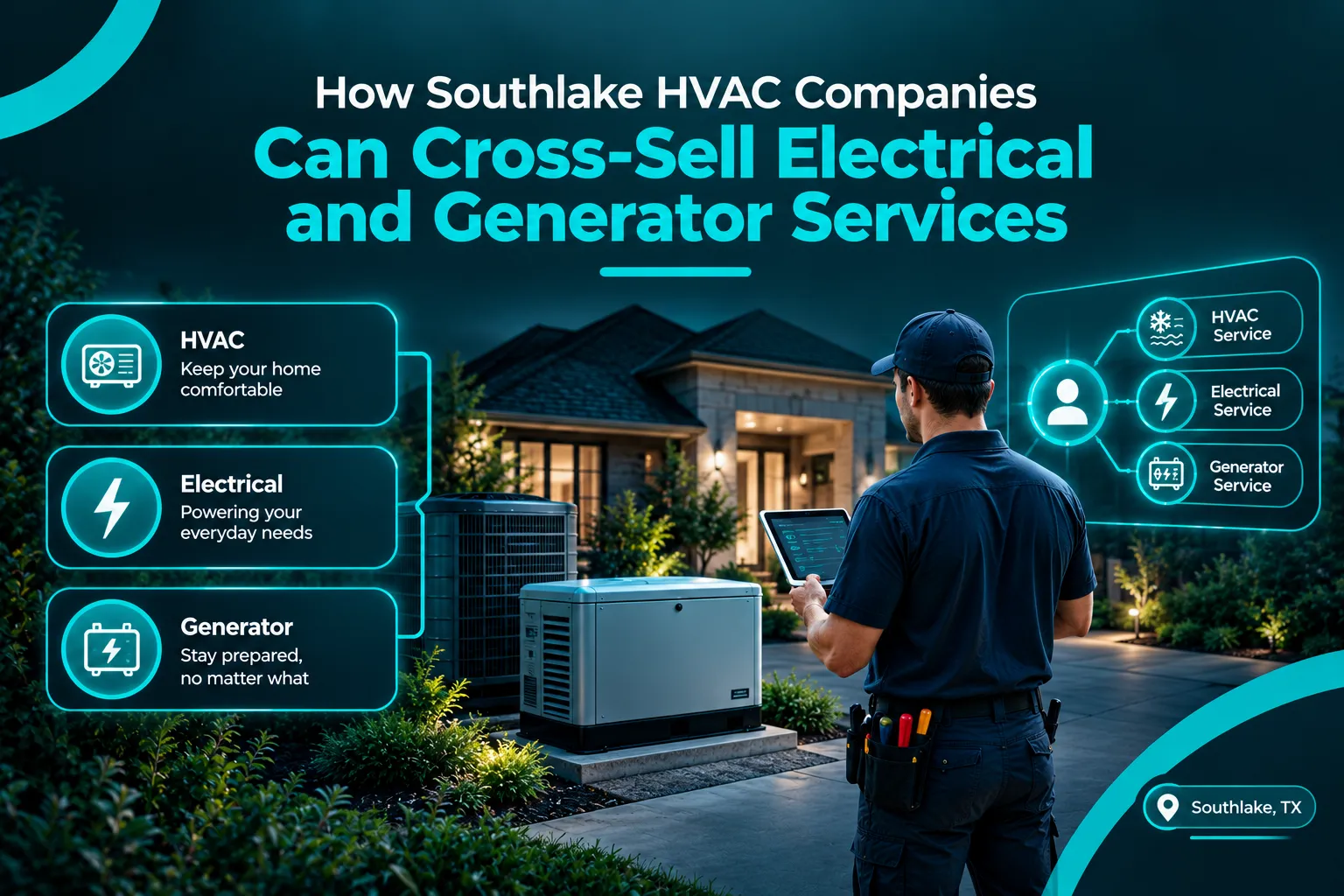
Why Should Southlake HVAC Companies Cross-Sell Electrical and Generator Services?
Cross-selling allows an HVAC contractor to introduce a complementary service that addresses another customer need. Instead of treating every service call as a one-time transaction, contractors can use established customer relationships to identify relevant opportunities.
For example, a homeowner planning a heat pump installation may need an electrical capacity assessment. Another customer experiencing frequent power interruptions may want information about a standby generator. In both cases, the HVAC contractor can explain the potential need and connect the homeowner with a qualified professional.
Industry research supports the broader opportunity. In an October 2026 report, The ACHR News cited a survey of nearly 800 homeowners in which 48% said they would be more likely to hire an HVAC contractor that also offered electrical services. Another 44% said the additional service would make no difference to their hiring decision. These findings suggest that offering complementary services can appeal to some customers, although results will vary by market and business model. Read the industry report.
Which Electrical Services Can HVAC Contractors Cross-Sell?
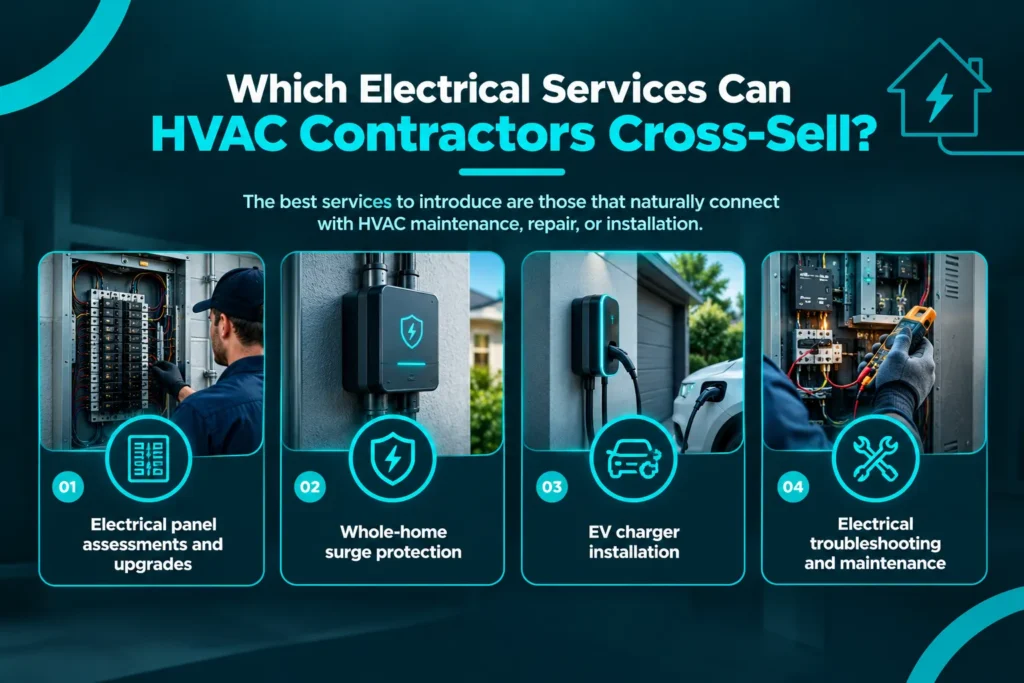
The best services to introduce are those that naturally connect with HVAC maintenance, repair, or installation.
1. Electrical panel assessments and upgrades
Electrical capacity can become relevant when homeowners consider equipment changes, including certain heat pump installations or other major electrical loads. An HVAC technician should not automatically recommend a panel upgrade, but can flag a concern for assessment by a licensed electrician.
A qualified electrical professional can determine whether the existing panel and circuits are suitable for the proposed equipment and whether additional work is necessary.
2. Whole-home surge protection
HVAC systems contain electrical and electronic components that can be affected by power disturbances. During a service visit, a technician can explain the purpose of surge protection when it is relevant to the home’s equipment and electrical setup.
A licensed electrician should assess compatibility, installation requirements, and the appropriate protection strategy.
3. EV charger installation
Homeowners considering an electric vehicle may also need electrical work. An HVAC contractor can identify this interest during a conversation about home upgrades and refer the customer to a qualified electrician.
This is most appropriate when the homeowner has already expressed interest in charging equipment or when the discussion naturally concerns upcoming electrical improvements.
4. Electrical troubleshooting and maintenance
Customers sometimes mention recurring breaker trips, flickering lights, or other electrical concerns during HVAC appointments. These issues should not be diagnosed beyond the technician’s qualifications.
Instead, the HVAC company can offer a referral to an appropriately licensed electrical contractor, giving the homeowner a clear next step.
How Can HVAC Companies Cross-Sell Standby Generators?
Standby generators are a particularly relevant complementary service because they address home backup-power needs rather than heating and cooling alone.
Identify homeowners with a practical backup-power concern
Potential conversations may arise when a customer asks about protecting home comfort during outages, maintaining essential equipment, or planning broader home improvements.
The contractor can ask whether the homeowner has considered backup power and offer an assessment through a qualified generator installer. Contractors can also improve customer communication and follow-up by exploring HVAC automation Southlake TX, particularly when they want to manage service inquiries, reminders, and customer relationships more consistently.
Explain what a generator assessment covers
A generator recommendation should be based on the home’s requirements, not a generic sales pitch. A qualified provider can evaluate:
- Which circuits and appliances the homeowner wants to power.
- The electrical load and appropriate generator capacity.
- Transfer-switch and panel requirements.
- Fuel availability and installation conditions.
- Permits, inspections, maintenance, and ongoing service needs.
The HVAC contractor can coordinate the referral but should not promise that a particular generator will support the entire home without a proper assessment.
Create a clear referral process
If the HVAC business does not employ qualified electrical professionals, a partnership with an established electrical or generator contractor may be the simplest starting point.
Agree on how leads are transferred, how quickly customers are contacted, who provides estimates, and how customer information is handled. Any referral compensation should be transparent and structured appropriately for applicable laws and licensing requirements.
When is the Best Time to Offer an Additional Service?
Timing influences whether a recommendation feels helpful or intrusive. The most effective approach connects the offer to a conversation the homeowner is already having.
Customer interaction | Potential cross-sell | Appropriate next step |
Heat pump installation planning | Electrical capacity assessment | Refer for a qualified evaluation |
HVAC maintenance visit | Surge protection discussion | Explain the option if relevant |
Customer asks about power outages | Standby generator assessment | Arrange a specialist consultation |
Home renovation discussion | Electrical upgrades | Ask permission to make a referral |
HVAC replacement estimate | Related electrical requirements | Include only verified, relevant work |
Technicians should document the customer’s interest and obtain permission before arranging follow-up. They should not pressure homeowners to make decisions during a repair visit.
A recommendation is more credible when the technician explains what prompted it, what remains uncertain, and which professional can evaluate the issue.
How Can CRM Automation Improve HVAC Cross-Selling in Southlake?
Even a good recommendation can be lost if the office never follows up. A customer might ask about a generator, receive an electrical referral, or request information about an upgrade, but forget the conversation before anyone contacts them.
CRM automation helps contractors record these opportunities and follow up consistently. For a broader view of connected workflows across multiple trades, explore AI automation home services Southlake to understand how contractors can organize lead management, scheduling, and customer follow-up.
1. Record the opportunity after each service visit
When a technician identifies a potential need, the office or field-service system can record the service discussed, the customer’s interest, and the next action. The record should distinguish between a confirmed request and a recommendation the customer has not accepted.
2. Send relevant follow-up messages
With appropriate consent, the system can send a short message acknowledging the conversation and asking whether the customer wants to schedule an assessment.
For example:
“Thanks for choosing us for your HVAC service. You mentioned that you were interested in backup-power options. Would you like us to connect you with a qualified generator specialist?”
This keeps the communication useful without implying that the customer has already agreed to buy.
3. Route leads to the right person
A CRM pipeline can separate generator inquiries, electrical referrals, and HVAC opportunities. Each record can have an assigned owner, next action, and follow-up date.
Contractors can also use an AI receptionist service Austin TX to help manage incoming calls and capture service inquiries before they are lost.
4. Follow up on open estimates
If a customer requests a generator or electrical estimate but does not proceed, a permission-based follow-up can ask whether they have questions or need more information. The goal is to make it easy to continue the conversation, not to send repeated messages indefinitely.
For a broader approach to connecting customer communication and service operations, see AICOADS’ HVAC marketing systems.
How Can Southlake HVAC Companies Build an Effective Cross-Selling Strategy?
A practical strategy does not require an HVAC business to launch an entirely new department immediately. Contractors can begin with a narrow service offering and expand after they understand customer demand and operational requirements.
Step 1: Review the existing customer database. Identify customers who have asked about home upgrades, backup power, or related electrical work. Use documented interests and relevant service history rather than assumptions about individual households.
Step 2: Choose one or two complementary services. Generator assessments and electrical referrals may be suitable starting points. Confirm that the business has qualified staff or reliable partners before promoting those services.
Step 3: Train technicians to identify and explain needs. Staff should know when to make a referral, how to document a customer’s interest, and when a matter falls outside their qualifications. Compensation plans should not encourage unnecessary recommendations.
Step 4: Create a follow-up workflow. Set up clear stages for the initial recommendation, customer permission, referral, estimate, and follow-up. Automation can help the office respond without requiring technicians to manage every sales task themselves. Businesses planning a more structured process can review this guide to CRM implementation Austin for additional guidance on organizing customer records and workflows.
Step 5: Measure the results. Track referral acceptance, appointments booked, estimates completed, conversion rates, revenue, customer feedback, and the cost of delivering each service. Review the results before investing in a larger program.
Contractors exploring broader operational improvements can also review AI automation for home services in Southlake. This topic should connect cross-selling with lead management, service coordination, and customer follow-up rather than repeat a general explanation of HVAC automation.
What Should HVAC Contractors Know About Licensing and Customer Trust?
Electrical work and generator installation require appropriate qualifications, and requirements depend on the work being performed. Texas contractors should verify applicable licensing, permitting, insurance, and code requirements before offering or advertising these services.
If the HVAC company does not hold the qualifications needed for a particular task, it should refer the work to a properly licensed contractor. Referral partnerships should clearly define responsibilities, scheduling, estimates, warranties, and customer communications.
Trust is equally important. Contractors should:
- Recommend additional services only when there is a reasonable basis.
- Explain why an assessment may be useful without exaggerating risks.
- Present estimates and scope clearly.
- Avoid guaranteeing savings, reliability, or performance without evidence.
- Obtain permission before sharing customer details with a referral partner.
- Respect customer communication preferences and applicable messaging rules.
These practices help cross-selling feel like customer service rather than pressure.
How Can AICOADS Help HVAC Companies Manage Cross-Selling Follow-Up?
Cross-selling creates opportunities only when customers receive consistent communication and the business can track what happens next. AICOADS helps home-service companies connect lead capture, CRM workflows, automated follow-up, and digital marketing into a more organized growth system. Businesses looking to connect their marketing and customer acquisition efforts can also explore AI marketing solutions Austin TX.
For Southlake HVAC contractors, the objective is not simply to generate more inquiries. It is to make sure relevant opportunities are recorded, routed to qualified professionals, and followed up with appropriately.
Ready to improve your HVAC lead management and follow-up process? Contact AICOADS to discuss an automation strategy suited to your business.