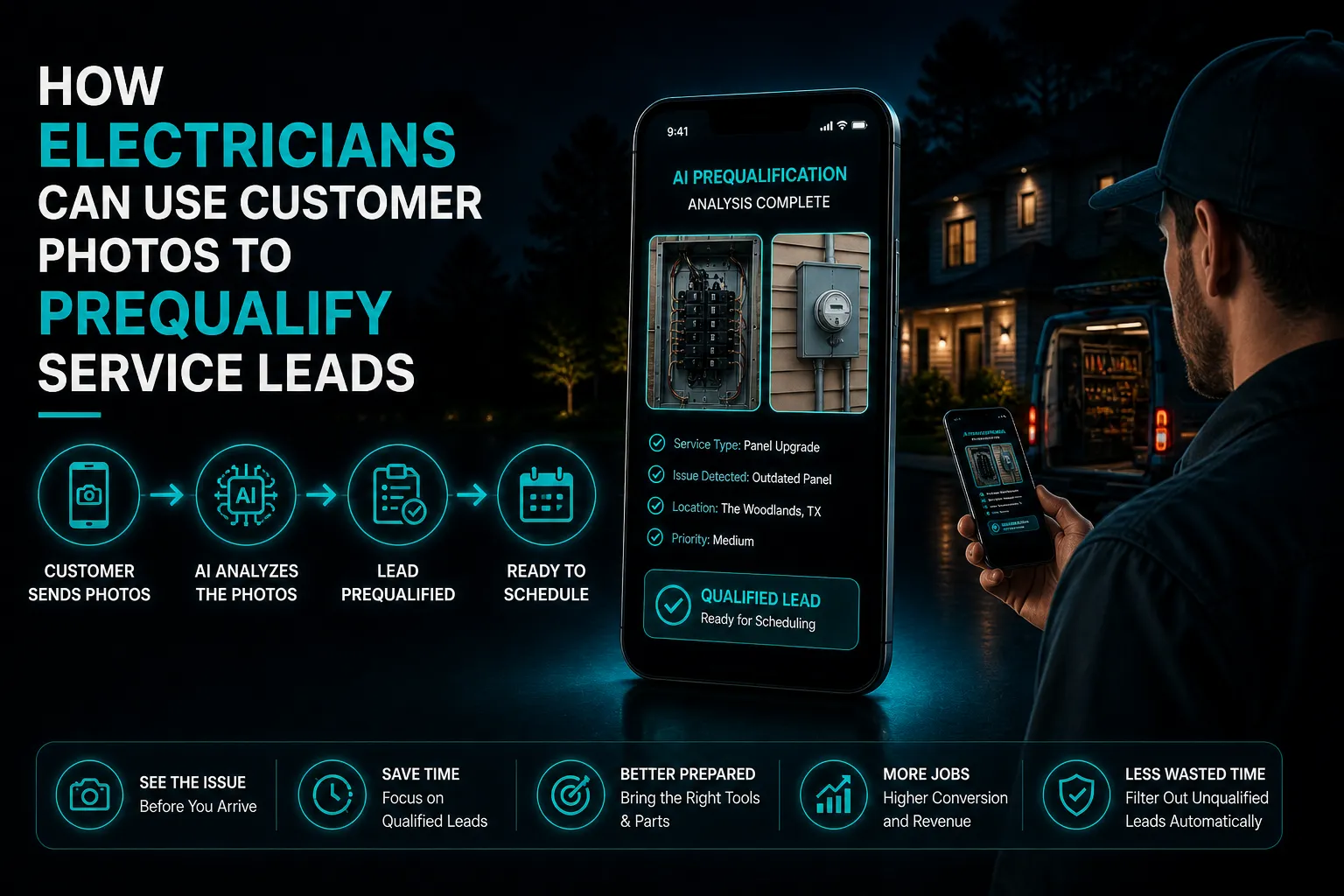
Why Should Electricians Use Customer Photos to Qualify Leads?
Customer photos provide visual context that a written description may not include. Someone requesting a lighting installation, outlet replacement, or electrical panel upgrade might struggle to explain the existing setup accurately. A suitable photo can help the electrician understand the visible work area and identify questions that need clarification.
Using photos during electrical contractor lead qualification can help businesses:
- Understand the general scope of a requested service.
- Identify missing information before arranging the next step.
- Prepare more relevant questions for the customer.
- Determine whether additional photos or an on-site assessment may be necessary.
- Organize inquiries according to service type and readiness.
For example, a customer requesting additional lighting might submit a photo of the room and the intended installation area. The electrician can review the visible conditions and ask about the number of fixtures, ceiling type, and project timeline.
Photos do not establish the complete electrical requirements of a job. However, they can make the initial conversation more productive and help contractors decide how to proceed.
Contractors looking to improve the entire customer journey can also review this guide to AI marketing and how it works.
What Photos Should Customers Send Before an Electrical Estimate?
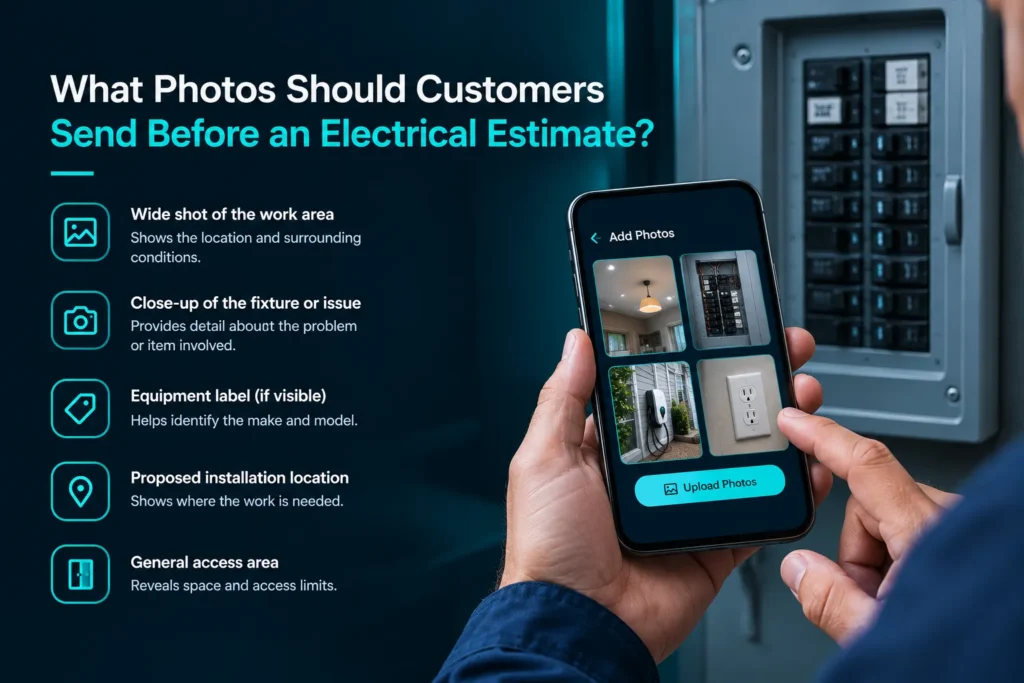
The most useful electrical job photos depend on the requested service. Electricians should provide simple instructions explaining which images would help them understand the inquiry.
Photo type | How it helps |
Wide photo of the work area | Shows the general location and surrounding conditions. |
Close-up of the fixture or visible issue | Provides context about the item involved in the request. |
Equipment label, when safely visible | May help identify the equipment’s make and model. |
Proposed installation location | Shows where the customer wants a fixture or equipment installed. |
General access area | Helps identify visible access constraints or space limitations. |
For example, someone requesting an EV charger installation could provide a photo of the intended parking area and relevant equipment that is safely visible. The electrician may then ask about the charger model, property type, and existing electrical service before determining the next step.
Safety must come first. Customers should never remove electrical panel covers, touch exposed wiring, or approach hazardous equipment to take photographs. Photos should only be requested when they can be obtained safely.
A well-designed inquiry form can make this process easier. Electricians can explore landing page optimization to understand how clearer forms and calls to action can help improve the customer inquiry experience.
How Do Customer Photos Help Electricians Prequalify Service Leads?
Photos work best when combined with customer information, service requirements, and location details. They are one part of a broader process to prequalify electrician leads, rather than a standalone measure of lead quality.
Electricians can use submitted images to support five qualification checks:
- Service fit: Does the customer need work the business actually offers?
- Service area: Is the property within the contractor’s coverage area?
- Job scope: Do the description and photos provide enough information to identify the likely next step?
- Project readiness: Is the customer looking for immediate service, a scheduled appointment, or a future installation?
- Missing information: Are additional details needed before the team can assess the request?
Consider a homeowner who submits a photo of a proposed lighting installation but does not explain the project timeline. The electrician can request that information rather than automatically treating the inquiry as unqualified.
This approach makes electrical contractor lead screening more useful because it separates genuinely unsuitable requests from potential customers who simply need to provide additional details.
How Can AI Automate Customer Photo Collection and Lead Qualification?
AI can help electrical contractors organize photo-based inquiries when the relevant forms, communication tools, and CRM support the required workflow. The goal is to collect better information and move each inquiry toward an appropriate next step.
A practical AI lead qualification workflow for electricians includes four stages:
- Capture the inquiry. Collect the customer’s contact details, service location, requested work, and description through a website form, chat, or supported communication channel.
- Request relevant photos. Provide job-specific instructions so customers know which images may help. Avoid asking for unnecessary photographs or unsafe access to electrical equipment.
- Identify missing details. Use automated questions to clarify the job type, property information, urgency, or other requirements. If image analysis is supported, AI may help organize visible information for human review.
- Route the lead. Send suitable inquiries to the appropriate team member, request clarification when details are incomplete, or schedule an assessment when needed.
Image interpretation depends on the capabilities and reliability of the connected tools. AI should not independently declare electrical equipment safe or provide a definitive diagnosis from a photograph.
Electrical contractors can explore AI automation for home service companies to see how automated workflows can help coordinate customer inquiries and follow-up across service operations.
What Electrical Jobs Can Benefit From Photo-Based Prequalification?
Photo-based intake can be useful for many common electrical service inquiries, particularly when customers can safely photograph the relevant area.
Service request | Useful initial information |
Lighting installation | Proposed fixture location, room layout, and fixture details. |
Additional outlets | Intended outlet location and general wall or room context. |
EV charger installation | Proposed parking location, charger model, and relevant visible equipment. |
Electrical panel upgrade | General exterior view of the panel and safely visible identification details, if available. |
Commercial electrical work | Photos of the relevant work area, project description, and property type. |
These examples help electricians understand the initial request and determine what additional information is necessary.
However, photos cannot reliably reveal concealed wiring, circuit capacity, hidden damage, or every condition that may affect installation. Complex projects may require technical information, an in-person assessment, or other professional checks before the contractor can provide a reliable estimate.
The purpose is to improve initial qualification—not to replace professional judgment.
When are Customer Photos Not Enough for an Electrical Estimate?
Customer photos are useful for initial screening, but some electrical jobs cannot be evaluated accurately from images alone.
For example, a photograph of an electrical panel does not necessarily establish its capacity, the condition of internal components, or whether the existing installation meets applicable requirements. Similarly, a picture of a malfunctioning outlet cannot reliably identify the underlying electrical fault.
Electricians should request additional information or arrange an appropriate professional assessment when a job involves:
- Concealed wiring or unknown circuit conditions.
- Suspected electrical faults or damaged components.
- Panel or service upgrades requiring verification.
- Complex installations with uncertain access or site conditions.
Customers should not be asked to investigate electrical faults themselves. If an inquiry describes an immediate electrical hazard, the contractor should follow appropriate emergency and safety procedures instead of relying on routine lead scoring.
Businesses planning a more structured setup can review this guide to CRM implementation for Austin businesses. Contractors already using field-service software can also explore Jobber and GoHighLevel integration to understand how customer information and follow-up workflows may be connected.
How Can Electricians Connect Photo Intake With CRM Automation?
Collecting photos is only useful if the business can associate them with the correct inquiry and act on the information.
With a compatible CRM and file-upload workflow, electrical contractors can:
- Keep customer details and photo references connected to the lead record.
- Notify the team when a new inquiry arrives.
- Create tasks when important information is missing.
- Assign follow-ups to the appropriate employee.
- Track whether the next step is clarification, a phone call, or a site visit.
Contractors can also combine photo intake with an AI receptionist for electrical contractors to help capture initial inquiries and direct customers into the appropriate workflow, where supported.
For businesses receiving inquiries across calls, forms, and chat, connecting these channels can make lead management more consistent. Access permissions and secure file handling should also be considered when storing customer images.
How Can Electricians Start Using Photo-Based Lead Qualification?
Electricians do not need to automate every service request immediately. Start with a few common job types and improve the process as the team learns which information is most useful.
- Identify the service requests that frequently arrive with incomplete details.
- Create a short photo checklist for each relevant job type.
- Add a photo-upload field or secure submission method to the inquiry process.
- Connect customer submissions with the CRM where supported.
- Review lead outcomes and refine the questions and routing rules.
Track whether photo submissions help the team prepare for appointments, reduce repetitive clarification, and identify the right next step. Avoid automatically rejecting customers who cannot provide photos.
A simple, well-managed process is more useful than a complicated system that creates unnecessary steps for customers.
A simple, well-managed process is more useful than a complicated system that creates unnecessary steps for customers. Before expanding automation, contractors can review CRM automation setup to understand the practical steps involved in organizing lead records and follow-up.
Frequently Asked Questions
How do customer photos help electricians qualify leads?
Customer photos give electricians visual context about a requested job. When combined with the customer’s description, location, and timeline, they can help contractors identify missing information and decide whether to request clarification or arrange an assessment.
What photos should customers send an electrician for a quote?
Customers can provide a wide photo of the work area, a close-up of the relevant fixture, or safely visible equipment identification details. The required images depend on the job. Customers should never expose wiring or remove electrical covers to take photos.
Can an electrician provide an estimate from photos alone?
Sometimes photos can support an initial estimate or preliminary discussion, but they do not reveal every electrical condition. The contractor may need additional details, technical checks, or an on-site assessment before confirming the scope and price.
Can AI analyze customer photos for electrical service requests?
Some AI tools can interpret images and help organize visible information. Their capabilities vary, and results require appropriate review. AI image analysis should not replace professional electrical diagnosis or safety assessments.
Should electricians reject leads that do not include photos?
No. Missing photos alone do not mean an inquiry is unsuitable. Electricians can ask follow-up questions, offer an alternative way to describe the job, or arrange an assessment when appropriate.
Improve Your Electrical Lead Qualification Process With AICOADS
Customer photos can help electricians collect better information, understand service requests, and prepare for the next step. When combined with AI lead qualification and CRM automation, they can support a more organized process from initial inquiry to follow-up.
AICOADS helps businesses explore automation workflows for lead capture, qualification, and customer communication. Contact AICOADS to discuss how a more structured lead management process could support your electrical contracting business.