Why After-Hours AC Leads Matter for West Lake Hills HVAC Companies
After-hours calls can represent customers who need service quickly. A homeowner dealing with an uncomfortable house may not want to wait until the next morning to start looking for help.
Several situations can create after-hours HVAC inquiries:
- An AC system stops cooling in the evening
- A homeowner notices unusual noises from the unit
- An existing system begins leaking
- A thermostat stops working
- A customer wants emergency service
- A homeowner wants to schedule an appointment for the next day
- A property owner needs information about an HVAC replacement
The problem is that many HVAC companies have limited office coverage outside normal working hours.
When an unanswered call goes directly to voicemail, the customer has to decide whether to leave a message and wait or contact another company.
A fast automated response gives the business another opportunity to start the conversation.
What Happens When an HVAC Company Misses an After-Hours Call?
A missed call does not automatically become a lost customer, but the longer the response takes, the more difficult it can be to keep the customer engaged.
A traditional process might look like this:
Customer calls → voicemail → customer waits → office reviews voicemail → callback → qualification → appointment
An automated workflow can shorten that process:
Customer calls → missed call detected → instant text → lead qualification → CRM → booking or human handoff
The customer receives a response while the need is still active.
For example, an automated message could say:
“Hi, we just missed your call. Are you having an AC problem, looking for maintenance, or trying to schedule service?”
The customer can respond by text, allowing the system to begin collecting the information needed by the HVAC team.
How Can HVAC Companies Capture AC Leads After Hours?
There are several parts of an after-hours lead system that can work together.
1. Automated Missed-Call Text-Back
The first step is responding when a call goes unanswered.
An automated text can acknowledge the missed call and invite the customer to explain what they need. This gives the homeowner a simple alternative to waiting for a callback.
The conversation can then continue through SMS rather than requiring the customer to repeatedly call the office.
2. AI Lead Qualification
Once the customer responds, an AI receptionist can ask predefined questions.
For an AC service request, those questions could include:
- Is your AC currently cooling?
- What problem are you experiencing?
- Is the system making unusual noises?
- Is there water leaking?
- Is this an emergency?
- What is the service address?
- Are you looking for repair, maintenance, or replacement?
- When would you like service?
The purpose is not to diagnose the equipment remotely. Instead, the AI collects useful information so the HVAC team understands the request before taking over.
3. Appointment Scheduling
If the customer is ready to schedule, the system can collect their preferred time.
When connected to an appropriate scheduling system, automation may also help customers select available appointment times.
This is especially useful for customers who contact an HVAC company outside office hours but simply want to schedule a service visit for the next available business day.
4. Follow-Up for Leads That Do Not Book
Not every customer will schedule immediately.
Someone may respond to the first text but stop before completing the process. Another customer may say they want to check their schedule first.
An automated follow-up workflow can keep those conversations organized.
Depending on the company’s rules, the system can:
- Follow up with an unanswered lead
- Remind a customer about an open service request
- Confirm appointment details
- Stop messaging after the customer books
- Route the conversation to an employee
This reduces the chance that an interested after-hours lead gets forgotten the next morning.
What Should an AI Ask an After-Hours AC Lead?
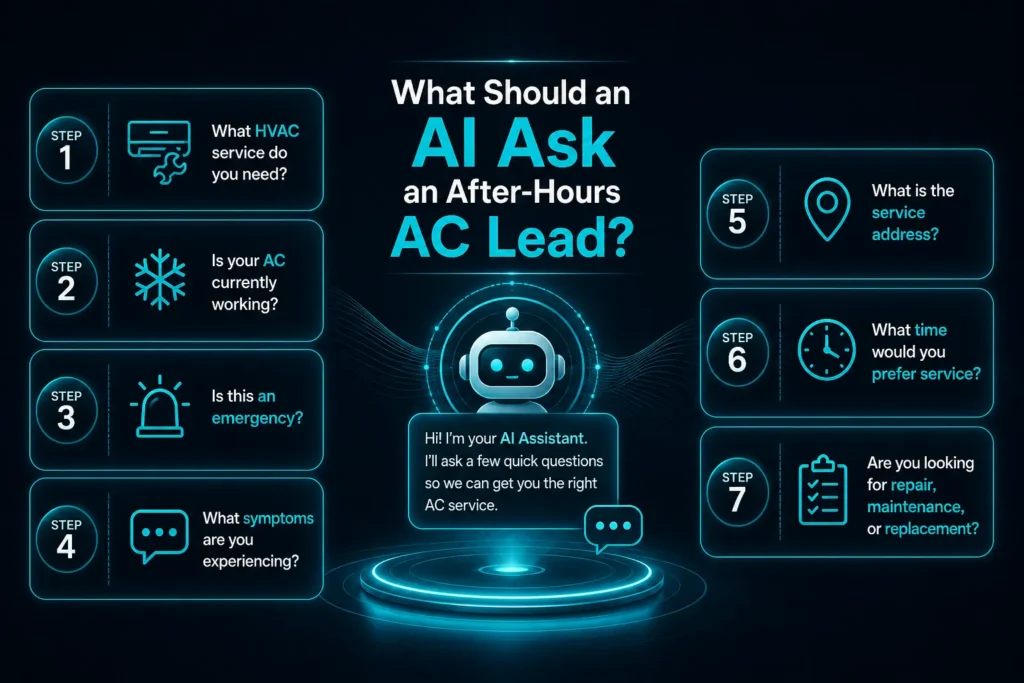
The questions should be short and directly related to the customer’s situation.
A useful qualification flow could be:
Step 1: What HVAC service do you need?
Step 2: Is your AC currently working?
Step 3: Is this an emergency?
Step 4: What symptoms are you experiencing?
Step 5: What is the service address?
Step 6: What time would you prefer service?
Step 7: Are you looking for repair, maintenance, or replacement?
The system can then organize the answers and pass the conversation to the appropriate workflow.
For example, an AC that is not cooling may require a service appointment, while a customer asking about a new system may need a sales consultation.
How Should HVAC Companies Handle Emergency AC Leads?
Emergency requests require particular care.
An AI receptionist can ask questions that help identify urgency, but it should not pretend to perform a technical diagnosis.
For example, if a customer reports an immediate HVAC issue, the automated workflow can identify the request as urgent and follow the company’s predefined escalation process.
Depending on the business, that could mean:
- Alerting an on-call employee
- Sending the lead to a dispatcher
- Providing approved emergency-service instructions
- Requesting the customer’s contact and property details
- Routing the conversation to a human
The important part is having clear rules before the system goes live.
Automation should support the HVAC team rather than make professional decisions that require a technician.
After-Hours HVAC Leads vs. Traditional Voicemail
Feature | Traditional Voicemail | Automated After-Hours Workflow |
Captures customer message | Yes | Yes |
Immediate two-way conversation | No | Yes |
Lead qualification | Manual | Can be automated |
Appointment workflow | Manual | Can be integrated |
Follow-up | Manual | Can be automated |
CRM data collection | Usually manual | Can be integrated |
Human handoff | Callback required | Can be triggered by rules |
Voicemail still has a place in customer communication, particularly when a customer wants to leave a detailed message.
The difference is that an automated workflow can give the customer another way to communicate immediately instead of making voicemail the only option.
How Can West Lake Hills HVAC Companies Turn After-Hours Leads Into Appointments?
The key is reducing the number of steps between the initial inquiry and the next action.
A practical workflow could look like this:
After-hours call
↓
Automated text response
↓
Customer explains AC issue
↓
AI asks qualification questions
↓
Customer information enters CRM
↓
Appointment requested or booked
↓
Human team takes over when needed
This workflow can also connect with other marketing channels.
For example, a homeowner may find an HVAC company through Google, visit the website, call after hours and then receive an automated text after the missed call.
The marketing campaign generates the lead, while the automated receptionist helps make sure the lead receives a response.
Once after-hours inquiries are captured, HVAC companies can connect them to a broader HVAC lead generation strategy in West Lake Hills that turns qualified prospects into booked service calls.
What Should HVAC Companies Track After Launch?
After-hours automation should be measured using actual business outcomes.
Useful metrics include:
- After-hours calls received
- Missed after-hours calls
- Automated texts sent
- Customer response rate
- Qualified AC leads
- Appointment requests
- Appointments booked
- Human handoffs
- Follow-up completion
- Recovered opportunities
- Average response time
Tracking these metrics can show where the process is working and where adjustments are needed.
For example, if many customers respond to the first text but few complete qualification, the questions or workflow may need to be simplified.
How to Set Up an After-Hours HVAC Lead System
West Lake Hills HVAC companies can build an after-hours workflow around their existing phone, CRM, and scheduling systems.
Start with these steps:
1. Identify After-Hours Call Types
Determine which services commonly generate calls outside office hours, such as AC repair, emergency service, maintenance, and replacement inquiries.
2. Create the Initial Response
Write a short automated message that sounds professional and makes it easy for the customer to respond.
3. Build HVAC Qualification Questions
Only ask questions that help the team understand the service request and determine the next step.
4. Define Emergency Escalation
Decide exactly when an employee should be notified or a conversation should be transferred.
5. Connect the CRM
Store lead details and conversation information so the team has context when following up.
6. Configure Scheduling
Allow customers to request or select appointments according to the company’s actual availability and scheduling rules.
7. Monitor the Results
Review response rates, qualified leads, booked appointments, and missed opportunities regularly.
Contractors using Jobber can also review how Jobber and Go High Level integration supports automated contractor follow-up.
Turn After-Hours AC Calls Into Booked Opportunities
After-hours demand gives West Lake Hills HVAC companies an opportunity to capture customers at the moment they start looking for help. The challenge is responding quickly without requiring office staff to remain available around the clock.
An automated missed-call response, AI receptionist, qualification workflow, CRM integration, and appointment system can work together to keep those leads moving.
The goal is simple: when a homeowner calls after hours, give them a clear way to get a response instead of sending them straight to voicemail.
For HVAC companies that already invest in local SEO, paid advertising, referrals, and other lead-generation channels, improving what happens after the phone rings can help create a more complete lead-management system.
Businesses looking to connect these processes with advertising, SEO, and conversion optimization can explore AICOADS’s AI marketing services for Austin contractors.