Why West Lake Hills HVAC Companies Miss Valuable Calls
HVAC businesses don’t miss calls because they don’t care about new customers. In many cases, the opposite is true: the team is simply too busy serving existing customers to answer every incoming call.
Common situations include:
- Technicians are already working on HVAC systems.
- Office staff are helping another customer.
- Multiple calls arrive during peak demand.
- Customers call before or after regular business hours.
- Emergency AC or heating calls come in when the team is unavailable.
- A technician cannot safely stop working to answer the phone.
- A customer hangs up before reaching voicemail.
West Lake Hills HVAC companies also compete for customers who may be contacting several providers at the same time. If someone needs an AC repair and cannot reach the first company they call, they may quickly move to another option.
What Happens After an HVAC Call Goes Unanswered?
The traditional process is simple:
Customer calls → nobody answers → customer leaves voicemail or hangs up → employee notices the missed call → employee calls back → customer may or may not answer.
The problem is the delay between the original call and the callback.
A customer who needed help at 6:30 p.m. may not still be available at 8:30 p.m. A homeowner who called about a broken AC may have already contacted another HVAC company.
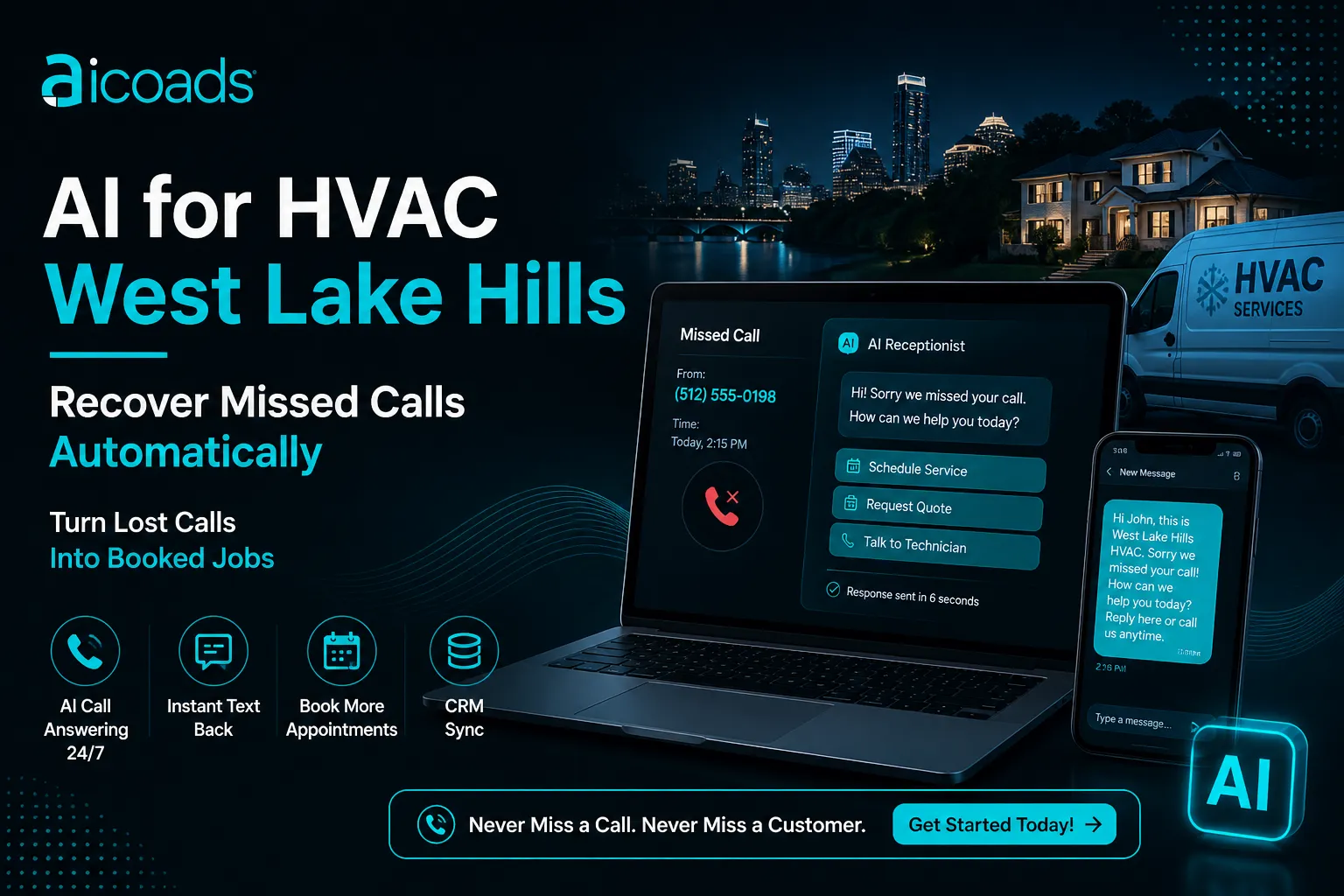
AI missed-call recovery changes that process by creating an immediate response after the unanswered call.
How AI Recovers a Missed HVAC Call
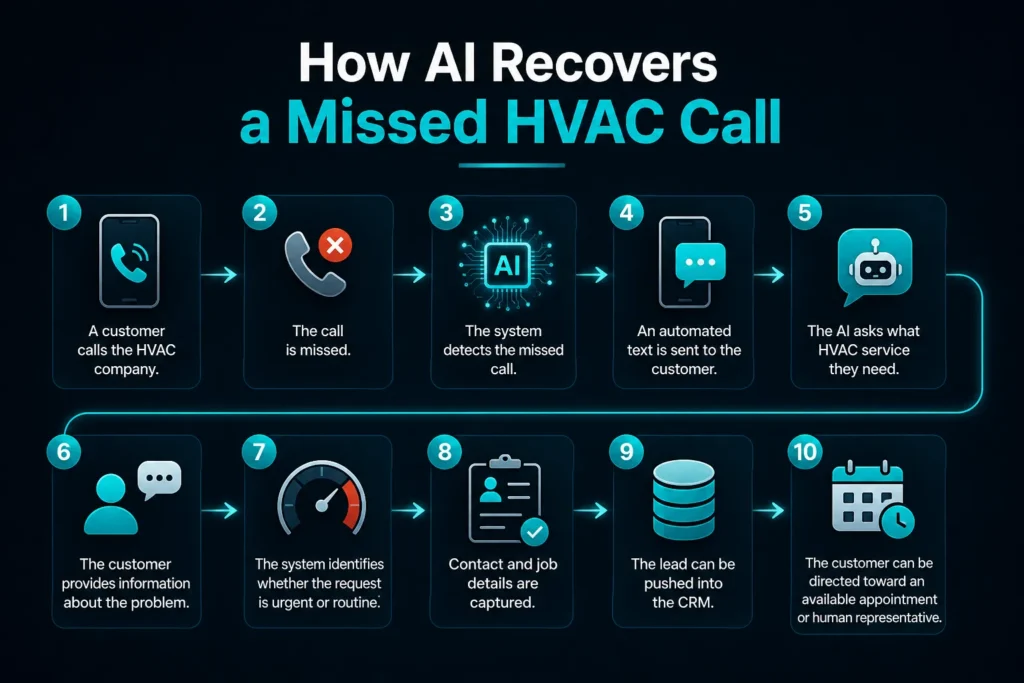
AI missed-call recovery automatically contacts a customer after an unanswered call, starts a text conversation, collects basic information and can route the lead toward booking or human follow-up.
The process can work like this:
- A customer calls the HVAC company.
- The call is missed.
- The system detects the missed call.
- An automated text is sent to the customer.
- The AI asks what HVAC service they need.
- The customer provides information about the problem.
- The system identifies whether the request is urgent or routine.
- Contact and job details are captured.
- The lead can be pushed into the CRM.
- The customer can be directed toward an available appointment or human representative.
Instead of making the customer wait for someone to notice the missed call, the business starts the conversation while the request is still fresh.
This approach is particularly useful for HVAC companies because customers may need help with time-sensitive problems such as an AC that stops cooling, a heating system that stops working or another urgent comfort issue.
What Can an AI Ask an HVAC Lead?
A useful HVAC AI system should do more than send a generic “Sorry we missed you” message.
It can be configured to collect information that helps the team understand the job before responding.
For example, an AI text conversation could ask:
- What HVAC service do you need?
- Is your AC or heating system currently working?
- Is this an emergency?
- What symptoms are you experiencing?
- What is the service address?
- Are you looking for repair, maintenance, or replacement?
- What type of system do you have?
- When would you like a technician to visit?
- Can you send photos if they would help explain the issue?
The exact questions should depend on the HVAC company’s services and workflow.
From Missed Call to Qualified HVAC Lead
The goal isn’t to replace the technician or office team.
The goal is to give them a better-qualified lead to work with.
For example, instead of receiving a CRM notification that simply says:
Missed call from John.
The team could receive information such as:
Service: AC repair
Issue: System running but not cooling
Urgency: Same-day request
Location: West Lake Hills
Preferred time: Afternoon
Customer: John
Phone: Captured automatically
That context can make the next human interaction more productive.
How AI Helps West Lake Hills HVAC Companies Book More Jobs
AI missed-call recovery can support several parts of the HVAC sales and service process. It can also complement a broader HVAC lead-generation strategy in West Lake Hills by helping businesses respond to and qualify the inquiries their marketing generates.
Faster Response
The customer receives a response shortly after the missed call rather than waiting for an employee to notice it.
Fast communication doesn’t guarantee that a customer will book, but it removes one common source of friction: waiting for a callback.
24/7 Lead Capture
An HVAC business may not have someone available to answer every call at night or on weekends.
AI can keep the initial conversation moving outside normal office hours.
This matters for businesses that advertise emergency HVAC service or serve customers with urgent heating and cooling problems. Several HVAC providers serving West Lake Hills publicly advertise emergency or extended-hours service, which reinforces how important after-hours communication can be in this market.
Better Lead Qualification
Instead of sending every inquiry directly to the sales or dispatch team, AI can collect basic information first.
This can help the team prioritize urgent requests and understand what the customer needs.
Automated Follow-Up
Not every missed-call lead will book immediately.
Some customers may respond later, need to check their schedule, or stop responding after the first message.
An automated workflow can follow up according to the business’s rules instead of relying entirely on employees to remember every lead.
CRM Visibility
Connecting the workflow to a CRM gives the team a central place to track conversations, contact information, lead status, and appointments.
That becomes even more useful when an HVAC company receives a high volume of calls during seasonal demand. Businesses using Jobber can also review how Jobber and Go High Level integration supports contractor follow-up and automation to understand how job-management and marketing workflows can work together.
AI Missed-Call Recovery vs. Traditional HVAC Callbacks
The difference is primarily speed and automation.
Traditional Callback | AI Missed-Call Recovery |
Employee notices missed call | System detects missed call |
Callback happens when staff are available | Text response can start immediately |
Customer explains the problem to staff | AI can collect initial details |
Qualification is manual | Initial qualification can be automated |
Follow-up depends on staff availability | Follow-up can be automated |
CRM updates may be manual | Lead data can flow into CRM workflows |
Limited after-hours coverage | Initial lead response can continue after hours |
AI does not eliminate the need for human staff. HVAC technicians still need to diagnose problems, provide estimates, perform repairs and communicate with customers.
The automation simply helps make sure an unanswered phone call doesn’t automatically end the conversation.
Which HVAC Calls Should Trigger AI Follow-Up?
A missed-call workflow can be configured around different HVAC services and customer scenarios.
Emergency AC Calls
A customer whose air conditioner has stopped working may want immediate assistance.
The AI can identify the issue, ask about urgency, collect the service address, and route the request according to the company’s emergency process.
Heating Problems
Heating-related calls can receive the same type of automated response, with questions tailored to the customer’s specific issue.
AC Repair Requests
For routine cooling problems, AI can collect the symptoms and preferred appointment time before passing the lead to the team.
Installation and Replacement Inquiries
Customers considering a new HVAC system can be asked about the property, existing equipment, project type, and preferred consultation time.
Maintenance Requests
Maintenance leads can be directed toward available scheduling options while the system captures customer information.
After-Hours Service Requests
This is where missed-call recovery can become particularly useful.
Instead of an unanswered evening call ending with voicemail, the customer can receive a text conversation that keeps the lead active until the team can take over.
How Much Can Missed HVAC Calls Cost a Business?
The financial impact depends on the company’s call volume, booking rate, average job value, service mix, and the percentage of missed calls.
A simple example illustrates the opportunity.
Suppose an HVAC company receives 100 inbound calls during a given period and misses 20 of them.
If 30% of qualified calls typically become booked jobs, those 20 unanswered calls represent up to 6 potential bookings before accounting for differences in lead quality or customer intent.
That does not mean all six customers would necessarily have become paying customers. Some may have been comparison shoppers, outside the service area, or looking for services the company doesn’t provide.
The point is that missed calls create a pool of opportunities that can be evaluated and potentially recovered.
For an HVAC company, tracking the actual results is more useful than relying on a generic industry revenue estimate. To estimate the potential financial impact using your own call volume and average job value, try the VoicemailTax missed-call cost calculator.
A real-world example is the Elite Air Conditioning HVAC marketing case study, which describes how call recovery, advertising, landing pages, and follow-up automation contributed to improved business results. Use case-study results as an example rather than a guarantee of what another company will achieve.
What Should HVAC Companies Track After Launch?
The most useful metrics are tied to the actual customer journey.
Track:
- Total inbound calls
- Total missed calls
- Missed-call response rate
- Customers who respond to the text
- Qualified HVAC leads
- Appointments requested
- Appointments booked
- Recovered opportunities
- Recovered jobs
- Revenue associated with recovered leads
- Average response time
The key metric isn’t simply how many texts the AI sends.
It’s whether the system helps the business move more qualified opportunities from missed call → conversation → appointment → completed job.
Turn Missed HVAC Calls Into Booked Opportunities
For West Lake Hills HVAC companies, missed calls don’t have to be the end of the customer journey.
A well-designed AI missed-call recovery system can respond quickly, ask relevant HVAC questions, identify urgent requests, capture customer information, automate follow-up, and connect qualified leads with the company’s CRM and booking workflow.
The technology works best when it complements the existing team rather than trying to replace it. Technicians remain focused on service calls while the automation handles the repetitive communication that can otherwise fall through the cracks.
If your HVAC company is receiving calls in West Lake Hills but doesn’t have a consistent process for recovering unanswered calls, AI missed-call recovery can turn that gap into a structured lead-generation and follow-up workflow.
Ready to See Where Your HVAC Leads Are Being Lost?
AICOADS helps home service businesses build AI-powered workflows for missed-call recovery, lead qualification, CRM automation, and appointment booking.