What are B2B Marketing Automation Services?
B2B marketing automation services use software, CRM platforms, and automated workflows to manage repetitive marketing and sales activities. These systems help businesses capture prospect information, organize leads, send relevant communications, and track interactions throughout the customer journey.
For example, when a business owner downloads a guide or submits a website form, an automation workflow can:
- Add the prospect to the CRM.
- Assign the lead to the appropriate sales representative.
- Send an introductory email.
- Schedule relevant follow-up messages.
- Notify the sales team when the prospect shows buying interest.
Instead of managing every interaction manually, businesses create repeatable processes that keep prospects engaged.
For a broader explanation of how these systems fit into modern business strategies, explore AICOADS’ guide to AI marketing.
What Do B2B Marketing Automation Services in Texas Include?
The right automation solution depends on a company’s sales process, audience, and existing technology. Most B2B marketing automation projects include several connected services.
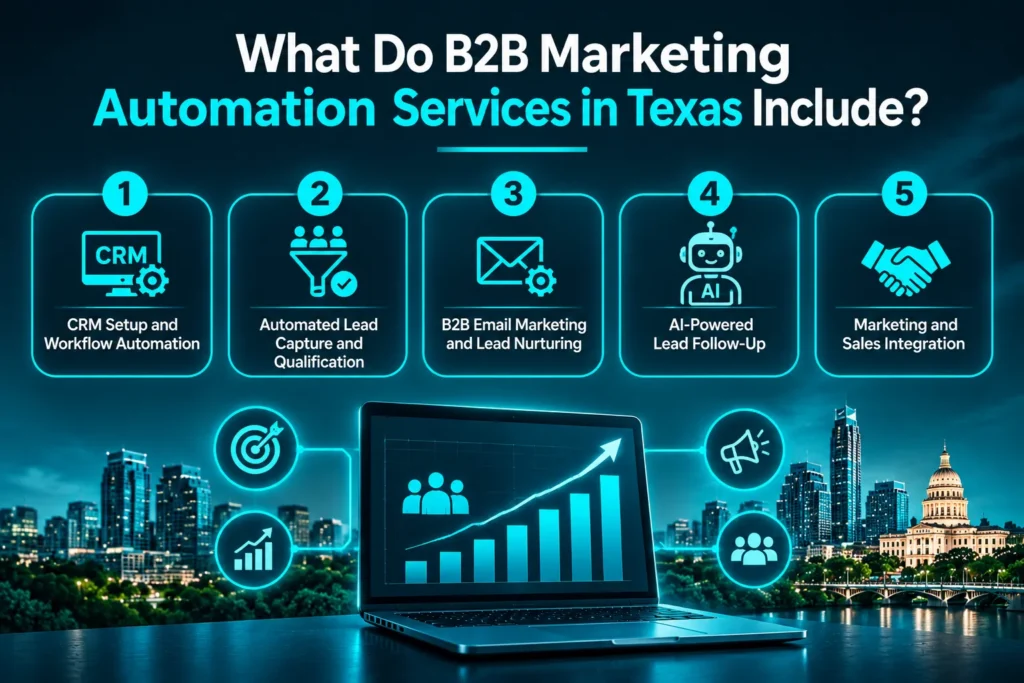
1. CRM Setup and Workflow Automation
CRM automation organizes prospect information and manages activities across the sales pipeline. Platforms such as GoHighLevel, HubSpot, and Salesforce can store contact records, track conversations, and trigger actions based on lead activity.
Common workflows include:
- Automatically creating contacts from website inquiries.
- Assigning leads to sales representatives.
- Updating pipeline stages.
- Sending reminders for pending follow-ups.
- Notifying teams when prospects request a consultation.
A properly configured CRM gives marketing and sales teams a shared view of prospect activity. Businesses can explore CRM automation services in Austin to understand how connected workflows support lead management.
2. Automated Lead Capture and Qualification
Generating leads is only the first step. Businesses also need a reliable way to collect prospect information and identify which inquiries deserve immediate attention.
Marketing automation connects website forms, landing pages, advertising campaigns, and other lead sources to a central CRM. Qualification workflows can then organize prospects using factors such as company size, industry, service requirements, budget, and purchase timeline.
For example, a software company can prioritize a prospect requesting an enterprise demonstration over someone downloading a general informational resource.
Companies looking to improve this process can also explore B2B lead generation for technology and software companies.
3. B2B Email Marketing and Lead Nurturing
B2B prospects rarely make purchasing decisions after one interaction. Automated email campaigns help businesses maintain communication while prospects compare solutions and evaluate providers.
A lead nurturing sequence might include:
- A welcome email after an inquiry.
- An educational resource explaining a common business challenge.
- A relevant case study or service overview.
- An invitation to schedule a consultation.
- A follow-up message if the prospect has not responded.
Messages can be adjusted according to industry, interests, and previous interactions. This makes communication more relevant than sending identical emails to every contact.
4. AI-Powered Lead Follow-Up
Slow responses can cause businesses to lose opportunities, especially when prospects contact multiple providers. AI-powered automation helps companies respond quickly and maintain consistent communication.
Depending on the system, automated follow-up can send emails or text messages, answer common questions, qualify inquiries, and offer appointment scheduling.
For example, a prospect submitting a consultation request after business hours can receive an immediate acknowledgment instead of waiting until the next working day.
Read more about automated lead follow-up for Austin businesses to see how these workflows support faster responses.
5. Marketing and Sales Integration
Marketing automation becomes more useful when advertising, outreach, website inquiries, and CRM activities work together.
Integrations can connect platforms such as Google Ads, LinkedIn, email marketing tools, scheduling applications, and CRM software. This helps teams understand where leads originate and what happens after the first interaction.
For outbound campaigns, tools such as Apollo, Clay, and LinkedIn Sales Navigator can support prospect research and personalized outreach. A connected system can then transfer interested prospects into the CRM for sales follow-up.
How Can Marketing Automation Help Texas B2B Companies Generate More Leads?
B2B marketing automation supports lead generation by improving what happens after a prospect discovers a business. Instead of allowing inquiries to sit in inboxes or spreadsheets, companies can build workflows that capture, organize, and nurture opportunities.
Key benefits include:
Business challenge | How automation helps |
Delayed responses | Sends immediate acknowledgments and follow-ups |
Disorganized contacts | Stores lead information in a central CRM |
Unqualified inquiries | Uses scoring and qualification rules |
Inconsistent nurturing | Sends scheduled, relevant communications |
Missed sales opportunities | Creates reminders and team notifications |
Limited campaign visibility | Tracks lead sources and pipeline activity |
Automation also helps businesses maintain communication throughout longer B2B sales cycles. A prospect who is not ready to purchase today can receive useful information and remain connected to the company until their needs change.
Companies building an outbound pipeline can also review AICOADS’ guide to SaaS lead generation in Austin.
Which Texas Businesses Benefit Most From B2B Marketing Automation?
Marketing automation can support almost any business with a repeatable sales process, but it is particularly useful for companies managing multiple prospects and longer decision-making cycles.
Technology and SaaS companies: Automate demo requests, trial onboarding, lead scoring, and sales follow-up.
Professional services firms: Organize consultation inquiries, send educational emails, and schedule appointments.
Manufacturing and industrial businesses: Manage distributor inquiries, quote requests, and long-term prospect relationships.
Commercial contractors and service providers: Capture project inquiries, qualify requirements, and coordinate sales communication.
B2B marketing agencies: Automate prospect outreach, client onboarding, reporting, and campaign workflows.
For startups developing their acquisition process, startup lead generation in Austin offers additional ideas for building a predictable pipeline.
How Do You Build an Effective B2B Marketing Automation Strategy?
Successful automation starts with a clear understanding of the sales process. Adding software without defining the workflows can create unnecessary complexity.
Follow these steps:
1. Identify Your Target Audience and Sales Process
Define your ideal customer profile, including industry, company size, decision-makers, and business needs. Map how prospects discover your business, become qualified, and move toward a purchase.
2. Choose the Right CRM and Automation Tools
Select a platform based on your requirements, existing systems, team size, and integration needs. GoHighLevel, HubSpot, and Salesforce are common options, but the best choice depends on your workflow.
3. Build Lead Capture and Nurturing Workflows
Connect website forms, landing pages, advertising, and outreach channels to your CRM. Create automated sequences for new inquiries, qualified leads, inactive prospects, and scheduled consultations.
4. Connect Marketing Automation With Sales
Make sure sales representatives receive relevant lead information and know when action is required. Automated notifications, tasks, and pipeline updates help prevent opportunities from being overlooked.
5. Track Performance and Improve Campaigns
Monitor lead response time, conversion rates, email engagement, qualified opportunities, and pipeline movement. Review workflow performance regularly and improve areas where prospects stop engaging.
Businesses that need a practical implementation roadmap can read the CRM automation setup guide for Austin businesses.
Frequently Asked Questions About B2B Marketing Automation
What do B2B marketing automation services include?
They typically include CRM setup, lead capture, email marketing, lead nurturing, lead scoring, automated follow-up, workflow development, and marketing platform integrations.
Is marketing automation suitable for small B2B companies?
Yes. Small businesses can start with simple CRM pipelines, automated email responses, lead notifications, and follow-up reminders. Additional workflows can be introduced as the sales process grows.
What is the difference between CRM and marketing automation?
A CRM stores and organizes customer information and tracks sales interactions. Marketing automation manages repetitive marketing activities such as email sequences, lead nurturing, segmentation, and campaign triggers. The two systems work best when connected.
How long does marketing automation implementation take?
Basic workflows may take days to configure, while more complex projects involving multiple platforms, custom integrations, and extensive testing can take several weeks. The timeline depends on the scope and quality of existing systems.
Which CRM is best for B2B marketing automation?
GoHighLevel, HubSpot, and Salesforce are popular options. The best platform depends on company size, sales complexity, budget, integrations, and reporting requirements.
Build a More Connected B2B Marketing System With AICOADS
B2B marketing automation helps Texas businesses reduce repetitive work, improve lead management, and maintain consistent communication with potential customers. From CRM implementation and lead nurturing to AI-powered follow-up, connected workflows can make marketing and sales operations easier to manage.
AICOADS helps businesses build AI-powered marketing and CRM systems that connect lead generation, automated follow-up, and sales workflows. If your company is ready to improve how it captures and manages opportunities, explore AICOADS’ marketing automation services or request a free AI audit to discuss your business requirements.